29 November 2009

Deserved

Long ago, a Norwegian TV reporter made a memorable contribution to sports broadcasting when his national team achieved a highly unlikely victory against England. Following Hull City's equally unlikely 1-1 draw with moneybags Manchester City yesterday afternoon, I shall imitate that famous Norwegian moment...

"Elsie Tanner! Noel Gallagher! Bernard Manning! NobbyStiles! Anthony Burgess! Ena Sharples! Gary Barlow! Morrissey! We gave your lads a helluva beating!" Actually it wasn't a beating it was just a draw but to the three thousand Hull City fans packed into the South Stand end of The City of Manchester Stadium, it certainly felt like victory when the inspirational Hull midfielder Jimmy Bullard managed to squeeze his penalty past the flailing arms of Man City's goalkeeper - Shay Given.

Money has been no object for Man City since Arab owners took over the club. Take the Brazilian Robinho for example - he alone cost an estimated £34 million. For such a sum of money you could replace the entire Hull City squad of forty four players twice over! So this was a real David v Goliath match and like David, my beloved Tigers showed far more grit, passion and togetherness than the Goliath club with its cossetted Ferrari driving mob of disunited stars.

And what a laugh it was when Mr Bullard lectured his team-mates in a spoof of last season's infamous halftime team talk by our manager Phil Brown when the lads were down by four goals to nil in the corresponding fixture. On BBC's "Match of the Day", legendary pundit Alan Shearer called it the best goal celebration ever.

Something I was very annoyed about yesterday was being bodysearched by security staff at the turnstiles. Only visiting fans are searched in this humiliating way - not home fans. Who vets the searchers? How are they trained? Jeez - we paid £29 each for a ticket and nowhere does it say on that ticket that you will be frisked by a stranger in a fluorescent jacket. I was searched at football matches several times in the distant past but this hasn't happened for a long time and I shall be firing off complaints in various directions about Man City's arrogant breach of basic human rights. They will wish they hadn't laid a finger on me.


They also made visiting fans remove bottle tops from any drinks they may have brought to the game. Yet this same club's safety stewards stood idly by while a small section of their supporters spent much of the match deliberately goading Hull City fans with foul-mouthed abuse instead of watching the football. Just not good enough - unlike the mighty Tigers who left the Commonwealth Games stadium with a richly deserved point.

26 November 2009

Brush

A paintbrush

As my last DIY blogpost seems to have gone down well with the intellectually-challenged readership of this blog, here's another...

Cue new theme music "You Can Leave Your Hat On" played on homemade bongos and a washboard by a naked expatriate teacher based in Bangkok. Credits... "I'm in a DIY Jam Get Me Outta Here"

"Good evening. In this programme, I will be focussing on a vital tool in the DIY kitbag - namely the paintbrush. Paintbrushes can be purchased from any reputable DIY store. They come in a range of sizes and are specially designed to make cleaning impossible so when the painting job is over it is best to just throw the bugger away and buy a new brush.

If you would prefer to make your own paintbrush you will need a wooden handle that you can easily carve from a piece of scrap timber and for the bristles you will need a grey squirrel. These vermin like Britney Spears, imported from America, have infested almost every corner of the United Kingdom but they are not easy to trap. We suggest an air rifle. When you have your squirrel carcass, remove the tail with some carpet scissors and affix to to your wooden handle with several lengths of gaffer tape. Before use, ensure the bristles are no longer twitching involuntarily.

Once you have a paintbrush in your hand you are ready to paint, assuming of course that you have previously purchased a tin of paint. Dip the brush in the paint, removing any excess drops and then using vertical movements back and forth apply the paint to your wall, door, window or mother-in-law. This act of painting helps tired or shabby rooms to take on a fresh new look.

When painting, make sure you wear suitable clothing as the paint is likely to get everywhere.
Yes folks. If you have never used a paintbrush before, it's time to get painting. Although it is a highly technical instrument, mastery of the paintbrush can be achieved after a few short years. So, make or buy a paintbrush and change your home.

Next week we will turn our DIY spotlight to hanging pictures on walls. Email in any questions you may have on this fascinating subject to yorkshirepudding@diyjam.co.uk . Until next week then, it's me Yorkshire Pudding wishing you a happy evening and keep on DIYing!"

Cue theme music and closing credits...

Squirrel tails

25 November 2009

Caulk


Welcome to "I'm In a DIY Jam Get Me Outta Here" Yorkshire Pudding's DIY tips programme.

"Hello everybody. I want to talk to you today about caulk - sometimes known as decorators' filler. You can buy it at any reputable DIY store. It generally comes in hard plastic tubes with an attached plastic nozzle. In order to dispense it, you need to nip off the end of the tube with a craft knife, screw on the plastic nozzle and place the whole tube in a caulking gun.
Especially in older houses but whenever you are decorating a room, you will find that the desired end finish is slightly spoilt by little gaps and cracks. They may appear where a skirting board meets the wall or where laminate edging strips butt up against the skirting or where window frames don't meet walls perfectly.
Get the gun and inject some caulk - either in long thin and even strips or just stop and fill if the crack or hole is particularly big. Unlike that horrible silicone stuff you have to use to waterproof edging in baths and showers, decorators' caulk can be nicely smoothed off with a damp cloth to produce a great end finish.
Good DIY results are to do with getting the detail right and caulk can help you to achieve an impressive finish. So instead of sitting on your fat ass exploring blogworld, get caulking!
Next week we'll be showing you how to create a floating duck house to beautify your pond or lake and the best bit is you won't have to pay a penny! We'll tell you how to claim back on your workplace expenses account...So till next week - Happy DIYing!"
(Cue theme music - "On Ilkley Moor Ba'Tat" played on homemade Trinidadian steel drums)

22 November 2009

Horcon

I took numerous pelican pictures but this was the best one.
During my South America days, I caught a local bus from Vina del Mar up the coast to a fishing village called Horcon. It was an assemblage of shacks and other unprepossessing buildings. You must appreciate that modern Chile is really a very new country - rather like the American mid-west - a product of the mid-nineteenth century. Okay there were Amerindian tribes thriving there for millennia before European exploitation but the Chile we see today owes very little to that heritage.
Down on the beach, muscular brown horses were pulling in fishing boats and a couple of weather-beaten fishermen were filleting their catch and throwing the squirming remains to gangs of waiting pelicans.
I ate fresh fish in a beachfront restaurant before wandering off to locate the bay of Cau-Cau with its picture postcard sands and Pacific waves. The journey back to Vina took an hour and a half - through the charmless township of Quintero about which my "Rough Guide" was very scathing.:-"Avoid this place at all costs" . I must say that that advice almost tempted me have a wander round Quintero but Rough Guides are invariably and uncannily spot on so I didn't bother. Anyway...dear readers...more photographs...
Beach horses working at Horcon
Feeding frenzy
Horse grazing by Cau-Cau beach.

Cau-Cau

19 November 2009

Ordinariness

Mid-November in the north of England. Days are short. Before you know it, the sun has gone over the houses and night-time is creeping in.

Christmas approaches relentlessly. Tinsel shines in shops. Potted baby Serbian pine trees wait in lines at B&Q stores to be adopted by families and bedecked with lights and ancient baubles hidden in attics since last January. Very few of these trees will survive central heating and the Queen's Christmas message.

Three mornings ago I chopped up an old loaf of bread and threw it on our back lawn for the birds but an urban fox emerged from the hedgerow for his breakfast. Glancing up furtively, he ate his fill and then brushtailed up the path I made this summer - past the compost bins and through the brambles.

I just finished "Bonfire of The Vanities" by Tom Wolfe - a huge tome of a novel, linguistically vibrant and passionate about the city of New York which is its ever-present backdrop. It was a really good read and I was pleased that I was able to devote many hours in relatively quick succession to the reading process. That is surely what good books deserve - not snatched half hours here and there when you're tired or travelling on a train to work.

Been sorting out our back room - the dining room. We used to have our computer station in an alcove next to the fireplace. I had used an old kitchen work surface to construct a built in unit but now we have moved the computer to the little room at the front of the house to make a proper study. This meant the decoration of the back room had to be disrupted so I have been stripping wallpaper, matching up new wallpaper and repainting. Not exactly my idea of a good time but we're getting there.

I am the live-in chef. When I was working, Shirley and I seemed to share kitchen duties but now I make all the main meals but I don't mind because I rather like cooking. What did we have tonight? It was a simple spaghetti concoction.

Fried up chopped onions, courgette, bacon and a couple of tomatoes in olive oil. Boiled the spaghetti and then mixed the two together with a small bowl of grated Parmesan. A couple of screws of black pepper and then ready to go. A delicious, simple and healthy meal - counterbalanced by the treacle pudding and cream that followed.

Time seems different these days. Once I blogged about "7:52"a.m. - which always seemed to be the time on the car clock when I set off for work along the same streets and avenues for twenty two years in a row. Now "7:52" doesn't seem to matter. It has lost its controlling power. If sleepy I can roll over and take another hour or two and at midnight the pressure to get to sleep in order to charge the old batteries for work has slunk away. I am not complaining.
Mid-November in the north of England. Days are short. Before you know it, the sun has gone over the houses and night-time is creeping in.

18 November 2009

Valparaiso

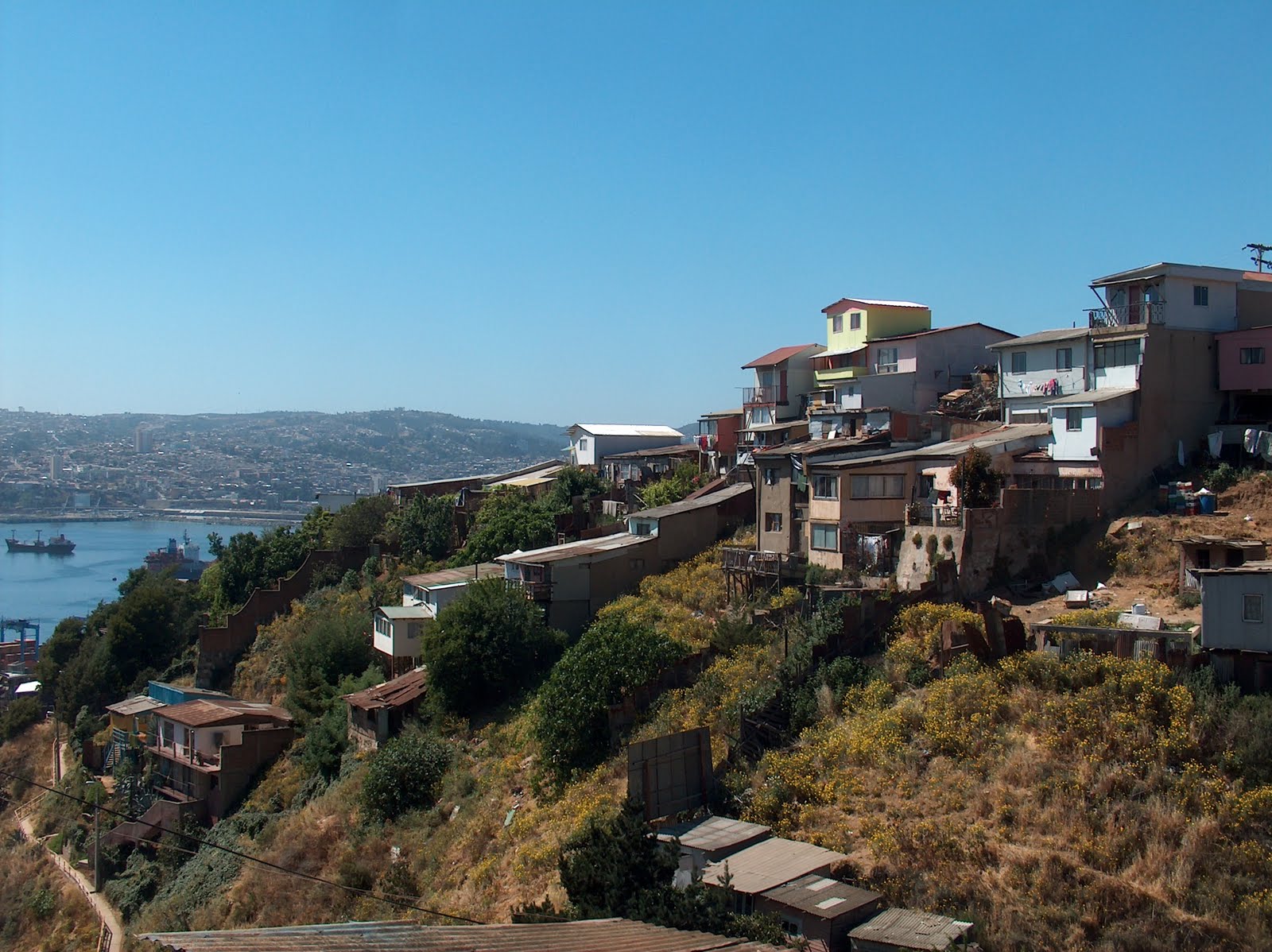
Valparaiso is Chile's premier seaport. Hills tumble down to the thin "plata" area adjacent to the port. Hence the city boasts no less than fifteen funicular railways that look as though they have not been modernised since they were constructed a hundred years ago.

The day I was there I was the sole passenger on the Ascensor Artilleria that lifts you up from the plata to the Naval Museum. I marvelled at the marine panorama before me. In the bay were container ships and the unmistakeable darkly elegant shape of a submarine just off shore.

I aimed to remain at that high level, planning to stroll horizontally around the roads that weave around Valpo's hills before dropping to the Concepcion area that was largely responsible for winning the city its treasured World Heritage status with its "improvised urban design".

So there I am strolling along at half ten in the morning, occasionally stopping to snap images of that colourful improvisation that grew without planning retrictions. I am looking out on a jumbled hillside in the sunshine when a man and a woman approached me all in a panic.

They were probaby in their forties and spoke no English whatsoever but I got the gist of what they were trying to tell me - that the area was dangerous. Bad "hombres" would come and steal my bag and my camera, maybe even slit my throat. The concern in their eyes was genuine and though I wanted to continue with my morning stroll as planned, I allowed them to more or less push me onto a local bus for the descent back to the plata.

Later I had a lovely three course lunch on the terrace of the Hotel Brighton - a distinctive orange and white building that overlooks the Sotomayor Plaza - where I chatted to the manager of a crane hire firm. The view from that terrace was spectacular and the lunch deal I chose was even called "Menu Bahia Vista" - View of the Bay menu. Whilst in translation mode, it tickled me to discover that Valparaiso simply and literally means "Paradise Valley". Given its rough seaport reputation it isn't a name you would automatically choose for the place.

There is a noticeable British influence around the city in street names, children's schoolwear and in certain buildings. Back in Victorian times, English merchants and bankers were prominent in Valpo. There is even a "British Arch" in the main avenue that runs parallel to the seafront.

Valparaiso Gallery:-

FROM TOP - Ascensor Artilleria, Housing in the hills, Hotel Brighton, Cat on Paseo Atkinson, Random window, The British Arch.

15 November 2009

Moai

The fifteen moai on Ahu Tongariki
Regarding the moai, I am not an archaeologist, scientist or theorist - I am just a guy who took a couple of aeroplanes to see them in their proper context.

Some facts. There are in total 887 moai "statues". Eleven were pillaged and taken elsewhere - one to the British Museum. On the island, some 357 moai can be found at the Rano Raraku crater which is where 95% of the "statues" were made from a volcanic "tuff" which was carved with a variety of harder stone tools. At this amazing quarry, a lot of finished moai are standing in sandpits, presumably ready to be moved to permanent positions elsewhere on the island. Some moai are half carved and others were rejected during the manufacturing process because of faults in the "tuff".

The moai that reached their ceremonial stone platforms all faced inland. Sadly, following contact with Europeans in the mid-eighteenth century, all of these statues were toppled. It is in any case believed that the moai making period lasted from about 1250 to 1550AD so that by the time the first Europeans began to call in, Easter Island's heyday was long past. The same applies to its forests. Studying pollen evidence, scientists deduce that by 1650 virtually all the trees were gone whereas back in the thirteenth century, the evidence says that there were many trees.
Toppled moai - these are in the majority
Whilst on the island, I of course didn't see all the moai there but I saw enough to realise that every one was different - different decorative carvings, slightly different expressions and textures, different heights and bellies. Some wore topknots or "pukao" made from red scoria stone and others didn't. The biggest moai ever moved to a platform weighed 75 tons but at the quarry there is an unfinished moai known as "El Gigante" which would have weighed an estimated 270 tons! Though there have been many theories, nobody knows for sure how the moai were moved - sometimes over ten miles.

On the day I visited Rano Raraku, there were perhaps fifty tourists keeping to the paths that weave around the moai on the crater's outer slopes. As it was mid-afternoon, the sun was in an awkward position for well-lit photography. It was a hot day and I of course had to put a knotted handkerchief on my head to avoid sunburn. This had the desired effect of driving the other visitors away because when I ventured inside the crater I was alone with older moai carved from the inner slopes. Here the light was in the right position for good photography.

A veritable herd of wild brown horses galloped into the crater and dived into the crater lake to drink and play and then they were gone leaving me alone with several moai of long ago. Their expressions were equally glum and ponderous as if they were sharing a secret, though one moai seemed to be smiling at me. I edged up to the crater's rim and looked towards the bay of Tongariki where fifteen re-erected statues look out from their "ahu" - spiritual guardians of a very different world from ours.

View of Rano Raraku crater lake with moai nose in foreground

The wry smile of the Yorkshire Pudding moai

Most Visits