9 January 2015

Mansfield

There's a Mansfield in Victoria, Australia:-
There's a Mansfield in Ohio, USA:-
And there's a Mansfield in Texas, USA. This Mansfield is famous because it was the hometown of Robert Brague - an award winning senior blogger who is now on a well-earned blogging vacation:-
But the real Mansfield, the town after which the other three are named, is in northern Nottinghamshire in England's East Midlands. It has a population of around 104,500 and was until recently  the capital of the county's productive coalfields. A little river runs through the town. It is called the River Maun and indeed in past times the settlement was known as Maunnesfeld or "field by the River Maun". The spelling we know today is derived from "Maunnesfeld".

I was there today. The town has a lovely central marketplace but it is surrounded by the remnants of rather misguided nineteen seventies town planning - dual carriageways and concrete shopping centres. There was a nice buzz about the centre of town but some umistakeable signs of working class poverty were apparent - mobility scooters, people puffing on cigarettes, obesity, shellsuits. That kind of thing.

I wish I could have stayed longer but I was restricted by the amount of change in my pocket when pulling into  into the pay and display car park near the old bus station.. Before leaving, I had a coffee and a sausage roll in the "Ten Green Bottles" coffee lounge. There, as I read "The Daily Mirror", I noticed a ten strong group of Romanian immigrants crowded around the window table and wondered if they supported the local football team - Mansfield Town - from whom  Hull City acquired the goalscoring legend who was Ken Wagstaff fifty years ago.

The real Mansfield-
The Bentinck Memorial, Mansfield
Church Street, Mansfield

8 January 2015

Charlie

  Paris, France - January 7th 2015  , The word balloon on the old cover of "Charlie Hebdo" reads - "A hundred lashes if you don't die of laughter". But I can't help thinking that in place of laughter, there will be many more tears in this new year as embittered Islamist nutcases wreak more deadly  terror in the name of a medieval religion they don't even understand. Who knows where it will all end?

Very soon after yesterday's vile attack in Paris, thousands of ordinary French citizens came on to the streets chanting "Je suis Charlie!" in anger, in solidarity and in love. So I say, "Je suis Charlie. I am Charlie too!"  For fraternity, for liberty, for equality. And dear reader, how about you, are you also Charlie?

7 January 2015

Bravo!

When ever I go to see a new film at the cinema, I am hoping to be wowed. At least hoping to come away thinking: "Now that was a damned good film".  But too often I am disappointed.

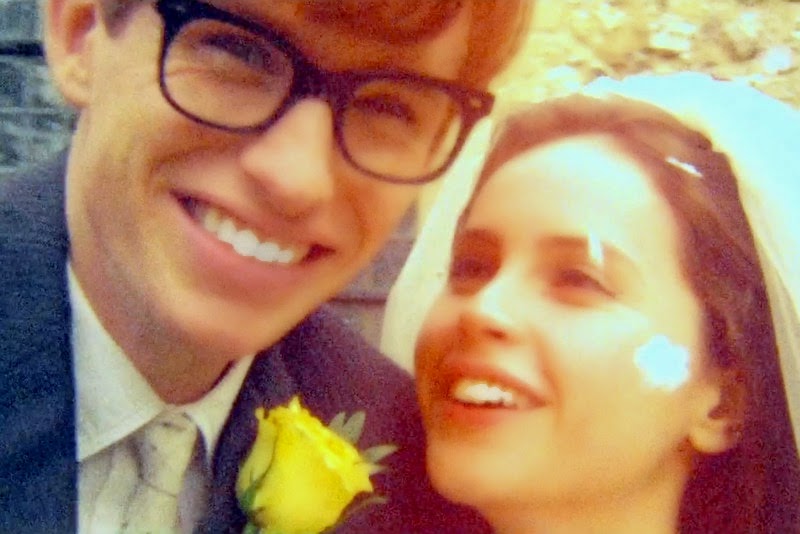
However, yesterday was more than good. Tears and laughter and total commitment to the cinematic illusion in front of my eyes - "The Theory of Everything" directed by James Marsh and based on a memoir by Jane Hawking: "Travelling to Infinity: My Life with Stephen".

Bravo! to Eddie Redmayne who played the Cambridge cosmologist Stephen Hawking with such sensitivity - imbuing the role with humour and humanity as we see the great academic's gradually developing battle with motor neurone disease - even as he strives to break new ground in understanding the nature of the universe in which we dwell.

And another "Bravo!" to Felicity Jones who played Stephen's wife. Her love for him overrode the practical hurdles that motor neurone disease placed in their way. They had three children and knew thirty years of wedded happiness before separating. The wheelchair-bound professor had found a new woman to love - his principal carer played by Maxine Peake.

It was a gentle, well-mannered film that convincingly takes you back to the cotton wool academic world of Cambridge in the early 1960's and beyond. No murders or bullets or car chases. Just people trying to get by - even though one of them has a very brilliant mind and an awful handicap. A very lovely film.

6 January 2015

Swift

The swift is one of the least understood and most mysterious birds. Though in shape it may look like the common swallow or the housemartin, there is no evolutionary or familial connection. It has closer links with the hummingbird. Astonishingly, ornithologists have identified a hundred different sub-species of the swift in four distinct tribes. The swift spends most of its life in the air where it feeds on flying insects, mates and sleeps - yes sleeps! - only returning to earth to make little nests of grasses and leaves which are attached to high rockfaces or the facades of old buildings with saliva. If you look at a swift's feet you will see that they are short, thin and stubby - designed for nesting times and nothing else. In flight, these feet are tucked nicely out of way like an aeroplane's undercarriage. The birds routinely fly to 10,000ft at night-time, around 4,000ft higher than previously thought. Swifts are also able to navigate through different wind speeds while sleeping, automatically adjusting their flight to stay on a specific course. Approximately 80,000 pairs of swifts migrate to Britain each summer, although numbers have been declining partly because modern buildings offer fewer opportunities for nest sites. The birds migrate more than 4,000 miles from Africa to England in late April. Typically, the swift will fly at 70mph but can achieve speeds of over 100mph, making it one of the fastest fliers in the animal kingdom. In flight, the average common swift will cover an estimated 125,000 miles a year. For all these reasons, surely the swift deserves our admiration and our protection too. 

5 January 2015

Lakes

The picture above - snipped from Google Maps - is a very small part of central Canada. Look at all those lakes! Even in that little rectangle there seem to be countless lakes. Out of idle curiosity I discovered that Canada has over three million lakes - about 60% of all the freshwater lakes in the world. 31,752 of Canada's lakes are over three square kilometres in area and 9% of Canada's total area is taken up by lakes. Amazingly, many of the lakes we can see courtesy of Google satellite imagery have still never been visited by human beings. 
Lake Pingualuk, Canada

3 January 2015

Queen

We met up with some old friends between Christmas and New Year - over a meal at the "Rama's Bridge" restaurant in Crookes. I have known John for 37 years and quite separately met Irene about 33 years ago. Almost bizarrely and unbeknown to me, they later got together after earlier relationships had gone sour and they had both experienced the trauma of divorce. It was quite a surprise when I discovered they'd found each other as at that time John lived out in the South Yorkshire sticks while Irene and her two little boys lived just around the corner from our old terraced house in Sheffield 10.

There are some friends with whom the ambience is so comfortable that conversation just tumbles out naturally - like a little mountain stream - just babbling along  and the four of us could talk together till the cows come home about football, children, holidays, food, films and even my nasty friend Gordon Gout who also happens to visit John from time to time. However, over the meal we discovered a difference of opinion that we had not realised beforehand.

For some reason we got on to The Queen and our royal family. It was clear that both John and Irene are anti-monarchists who resent what they see as a costly and pointless anachronism in our midst. In contrast, Shirley and I are proud of  Queen Elizabeth II, proud of the way she has represented our country these last sixty three years and more than comfortable with the continuing existence of the British monarchy. (Adrian is foaming at the mouth at this point)

Irene asked, "But what has she done for us? What has she done for you?"

Since the meal at Crookes, I have been pondering that question. And there is a sense in which The Queen hasn't done anything for us. She hasn't made us any curtains or ironed a basket of laundry. She hasn't sent us a nice fat cheque when money was short or climbed on the roof to fix our television aerial. But what she has done is to provide a wholesome national symbolism - a calm and intelligent point of reference in a swirling, chaotic world. She stands for continuity and national pride as politicians and charlatans have come and gone like the leaves from autumn trees. Elizabeth has been there - dignified, part of a line that travels way back in history. She is on our stamps and our coins and for me and Shirley, like the majority of Britons,  she is in our hearts. (Adrian has collapsed)

Though I am all for Elizabeth II and for Charles III and William V and much later George VII - what I am very much against is all the other privileged and aristocratic hangers-on. The dukes and the earls, the lesser royals and so on. If I had my way, they would all have to work for a living and dwell in ordinary houses like the rest of us. They'd be bus drivers and health care assistants, farm labourers and shopkeepers. None of the usual aristocratic social whirl - The Henley Regatta, The Badminton Horse Trials, Wimbledon, Cowes. No banquets or grouse shooting. No tax breaks or tweeds and certainly no FA Cup Final tickets. They would have to queue up for hours like the rest of us.

But as for our happy and glorious Queen Elizabeth II, it will be one of the saddest days of my life when The Grim Reaper finally takes her to his dark and deathly cavern. The whole world will be watching. Until then -  God Save The Queen!

2 January 2015

Lodge

This is Warren Lodge. It sits beneath a Derbyshire millstone escarpment known as Curbar Edge. It was erected in 1877 under the instructions of The Earl of Rutland. And why is it called Warren Lodge? Quite simply because it was where the estate's main rabbit warren was located. It housed the head rabbit keeper whose job was to ensure that when the Earl and his aristocratic chums decided they wanted to shoot rabbits there would be plenty to blast away at. It is reported that on Boxing Day 1933, four bloodthirsty men dispatched over 700 rabbits in the vicinity of Warren Lodge. It sits high above the valley of the River Derwent near the villages of Curbar and Calver and I stopped to photograph it this very afternoon as the bright winter sun was beginning to sink over the western peaks.

Most Visits