7 February 2016

Cinemagraph

Obviously, John Gray over at "Going Gently" is a computer whizzkid. Recently, I noticed rather spooky moving pictures in his blog and wondered what the hell was going on! Were my eyes deceiving me? How had John achieved this illusion?

A little bit of investigation and I discovered that these pictures are called "cinemagraphs". It is possible to make your own cinemagraphs if you have the time, patience and right equipment but  that didn't apply to me so instead I went to a website called  cinemagraphs.com where I found the picture at the top of this post.

It's a never ending book. The pages keep turning forever. Turned by an invisible hand or perhaps flicked over by the draught from an open window. But what is written upon them? Is it a diary or maybe just a  handwritten list of items purchased from shops - till receipts carefully copied out ad infinitum. Looking closer, I see it's a passport with stamps recording travel that went on forever and ever. Amen.

6 February 2016

Teacherism

Racism is when someone is treated differently or unfairly just because of their race or culture. People can also experience prejudice because of their religion or nationality. It is illegal to treat people differently or unfairly because of their race.
Childline Charity website
Sidney Poitier in "To Sir With Love" (1967)
It can be difficult but in my life I strive to avoid prejudice and expect that the vast majority of readers of this blogpost also try to live lives that are not sullied with prejudice. Prejudice is the domain of the ill-informed, the cruel and the stupid. In extremis, prejudice may cause war, murder, torture, arson and other horrible manifestations of prejudicial thinking.

In quieter, everyday terms, prejudice may simply cause other people to be unhappy and feel alienated, misunderstood, belittled.

Because I rarely bang on about it, some visitors to this blog may be unaware that for thirty five years of my life, the way that I earned money was through teaching. So naturally, I know a lot about teachers. This despite the fact that none of my three brothers were teachers and despite the fact that socially I tended to avoid teachers because I didn't want work to overlap into my social time. I preferred to talk with joiners, plumbers, warehousemen, guitarists, the unemployed and nurses. In fact, how they happened to earn money didn't really mean much to me. People are much more than the jobs they do. Though my job was teaching that was never who I was.

In those thirty five years, the main thing I discovered about teachers is that they are all different. They are not like a shoal of mackerel swimming in the sea - all pretty much the same. To begin with you have different subjects and P.E. teachers may be noticeably different from say English teachers or Science teachers. You have got women teachers and men teachers, black teachers and gay teachers, inner city teachers and teachers working in cushy little private schools, teachers with disabilities and teachers who are so passionate about their work that they gladly put in sixty or seventy hours a week, secretly toiling at their desks during the holidays and late into the night. Commitment beyond the call of duty that "The Daily Mail" and the general public never see. Equally, you can have lazy teachers who do the bare minimum to get by but these are generally "found out" by the children they face each day.

In short, teaching is like any other job. Everybody's different and therefore it is surely ignorant to lump all teachers together. Would we say - I hate nurses or - I hate engineers? No. For that would clearly be stupid  prejudice. I call the blanket judging of teachers teacherism and in recent days I have discovered quite a bit of teacherism within the blogosphere. Quite surprising really and from  my point of view very objectionable.

One blogger suggested that all teachers are miserable, they talk about nothing but teaching and they have summer beach holidays that last six weeks or more. Another said he had taught in a private school for a couple of years when he was younger and it was much harder than working in a state school - even though he had never taught in a challenging urban area or dealt with children from disadvantaged  homes! Such correspondents are clearly teacherists and in my opinion teacherism belongs in the same bag as racism and sexism. It's all prejudice.

In general, this country's schoolteachers are doing a damned good job of  serving our nation's children to the best of their ability. It is an important role - not made any easier by interfering politicians, the squeeze on resources, sensationalist newspapers, large class sizes and ignorant teacherists who deride the profession and wear their sneering teacherism on their sleeves. Thankfully, most parents, most schoolchildren and most fair-minded members of the general public appreciate the sterling efforts of our largely gifted teaching force and these bigoted teacherists are very much in the minority.

George Bernard Shaw's silly but oft-quoted "Man and Superman" line -  "Those who can do, those who can't teach" should probably be extended to read - "Those who can do. those who can't teach and those who can neither do or teach wallow in ignorant teacherism."

Bury

Yesterday morning the postman hammered on our door. He had lugged a sackful of letters up the street. I poured them upon our kitchen floor and began to rip them open. They were all from other bloggers and almost unanimously they were begging me to post some more pictures of Bury in Lancashire. Frankly, I had no idea that Bury was such a popular place! 

A jolly fellow residing in Canton, Georgia said, "Until you post some pictures of Bury my life will be incomplete." Former prison blogger Ian Rhodes at the newly refurbished Shooting Parrots blog said, "Bury holds special memories for me as it was there that I first learnt to clog dance" while Laughing Horse Blogger of the Year Lee from the hippy commune on Tamborine Mountain in Australia said. "If you post pictures of Bury I will alter my will  - making you the sole beneficiary."

So by special request, here for all the blogosphere to enjoy are six rather random pictures of Bury taken last Saturday... 
At Bury F.C.'s Gigg Lane Stadium
Neon poem at Bury Transport Interchange
Cafe in Bury Market
Crompton Street
Statue of Robert Peel and "The Robert Peel" pub
Former town centre pub.
Now an Indian restaurant.
This blogpost was sponsored by Bury Tourism Authority, Bury College, Bury Chamber of Commerce and the family of the late Dee Brown, author of "Bury My Heart at Wounded Knee".

4 February 2016

Spotlight

Set in Boston USA fifteen years ago, this film focuses upon the work of an investigative team  at "The Boston Globe". They had the onerous and complex task of shining their spotlight upon The Roman Catholic church - not just the eighty seven priests the team had identified as serial child abusers but also upon the church as an organisation  - an organisation that cynically and repeatedly tried to bury the truth about sexual abuse of children by priests in the Boston archdiocese.

It's not an easy film to follow. It's fast-moving and the way the investigation develops is not always clearly spelt out. You really have to concentrate just as the team of dedicated reporters had to concentrate upon the difficult task at hand. There's no love interest or sensational depictions of past abuse. Instead, the screenplay is measured, educative and serious - befitting the subject matter.

If I was going to single out a particular performance for praise, it would have to be Mark Ruffalo's portrayal of Michael Rezendes. In pursuing the truth, he was like a dog with a bone but that pursuit was coloured with compassion, anger, frustration and occasional disbelief. These were the same feelings that touched the rest of the Spotlight team.
___________________________________

So that was the film but what about the subject matter?

It is mind-boggling that so many men of the cloth used their positions to prey upon vulnerable boys and girls. They used a range of cunning psychological devices to keep those children quiet and even to instil in them feelings of guilt about the sordid activities they had been drawn into. Of course, this didn't just happen in Boston.

There were abusive Catholic priests all over the world and even today we have no guarantee that similar abuse isn't happening. Ministering to communities should surely be all about kindness and other decent Christian  values. The priests who manipulated children to achieve sexual relief ruined so many lives. They also brought shame and suspicion upon righteous priests  who were always in the majority.

It is chilling to recognise that the litany of child abuse was well-known to the Catholic hierarchy. It was in files and correspondence but rather than confront the horror they chose to sweep it under the carpet. Guilty priests were moved on to new parishes or sent to other countries where their vile. abuse simply continued.

How must it be to reach adulthood with dark memories of being sexually abused? Thankfully I have no idea because it never happened to me but I can imagine that it is a terrible burden to bear and guess that there are no magic wands or psychotherapy sessions that could ever make the nightmare go away. My heart goes out to all the victims - thousands of them over countless years.

2 February 2016

Black

What do foreigners think of when they hear the name "England"? William Shakespeare, Queen Elizabeth II, The Beatles, Big Ben, Tower Bridge, Hull City A.F.C., Charles Dickens, Mary Poppins, Winston Churchill. Morris dancers and Cornish cream teas perhaps?  But I wonder how many think of the humble black pudding? Yes, my friend, black pudding.

What is a black pudding? Sausage-like in appearance, it is generally made from pork fat or beef suet, pig's blood and a relatively high proportion of oatmeal. In some recipes it may be mixed with grits (oat groats) and  occasionally even barley groats. As it happens, the world's epicentre for the manufacture of black puddings is Bury in Lancashire.

Naturally, when I was over there on Saturday, I made a point of visiting Chadwick's Black Pudding Stall in Bury Market. This little food company produces and sells nothing else but black puddings. Like the two customers in front of me I asked for a "lean one" which cost me £1.08. 

Yesterday lunchtime, I ate half of it with some bacon, a fried egg, a grilled tomato and a slice of bread and butter. The black pudding was delicious - rich and nicely seasoned. I grilled my black pudding slices along with the bacon and the tomato.  A lovely treat to mark the beginning of February and for your interest photographs were taken to capture this delightful culinary experience...

1 February 2016

Artwork

Irene aged 86 and 3/4 by Patricia Leontieff (Bury Art Society) (2015)
In London they might have art galleries with black business cards scattered on the floor but Up North we have proper galleries with proper pictures. Real Art.

The nineteenth century saw the rapid growth and booming prosperity of Pennine textile towns like Burnley, Oldham, Bradford, Halifax and Bury. The mill owners might have exploited their workers by paying paltry wages and providing cheap slum housing but rather ironically they could also be generous  civic benefactors, investing in parks, hospitals, transport links and art galleries.

Much great art was brought to northern England towards the end of the nineteenth century to be displayed proudly for the edification of townsfolk. And despite the best efforts of the Luftwaffe, much of that fine Art remains here, invariably housed in magnificent Victorian buildings.
Bury Art Gallery
Bury Art Museum - picture from Bury Art Society website
On Saturday in Bury, I made a point of visiting the town's lovely Art Museum. One of the main rooms was devoted to a display of works by members of Bury Art Society. In the next two galleries you could see some of the legacy of the town's industrial past - pictures that were bought with profits derived from the labours of spinners, weavers, dyers and bleachers. But those pictures did not concern themselves with  the reality of working life in the valley of The River Irwell. Instead they took onlookers away to far more exotic places than  Bury. A kind of cultural escapism.

Apart from the staff and some people preparing for a drawing class, I was the Art Museum's only visitor at midday on Saturday and so I had the town's magnificent Art to myself. Here is a little more of what I saw:-
Calais Sands at Low Water: Poissards Collecting Bait
by J.M.W. Turner (1830)
The Random Shot
by Sir Edin Landseer (1848)
Moor at Prayer 
by Ludwig Deutsch (1898)

31 January 2016

Dedication

It was perishing in Bury yesterday. I had driven across the Pennine hills to the northern Manchester area to watch my beloved Hull City put our Lancashire hosts to the sword with a hat-trick from Arsenal loanee Chuba Akpom. It was bitterly cold at the historic Gigg Lane Stadium with hail and snow amidst spells of sunshine. Thankfully, I had had the foresight to purchase a woolly hat from Bury Market. A snip at £2 and red for visibility when out walking.

I had arrived in Bury for the very first time at 10,30am, after a journey from home that took exactly one hour and fifteen minutes. Logically, my expectation was that the journey home would take roughly the same amount of time. 

Sheffield and Manchester are only thirty five miles apart but the most direct roads over the wild hills between these important northern cities are windy, double track routes - The Snake Pass and The Woodhead Pass. We tend to use The Snake Pass as it brings us into our city's south western suburbs whereas The Woodhead Pass brings you first to Stocksbridge and then Hillsborough to the north of the city.

From the M60 Manchester ring road I took the M67 to Mottram and thence to Glossop. All was fine but given the cold and wintry showers, I had a nagging feeling that getting across The Snake Pass beyond Glossop could be problematic. However, I reached the moorland summit without incident or significant concern and that's when I wished I had used a different route.
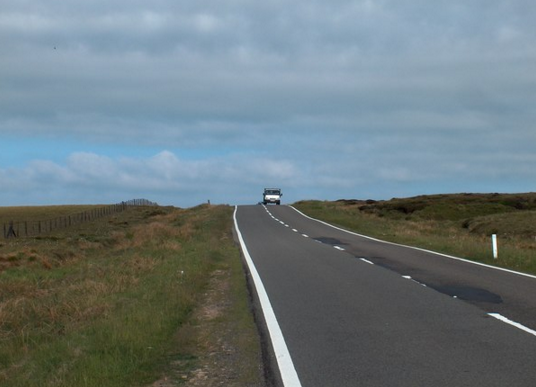
A57 Snake Pass summit on a pleasant day in June
There was a police vehicle up ahead with blue lights flashing in the blackness as a blizzard blustered around. A few other cars were turning around and heading back to Glossop. I noticed a BMW slipping and sliding about and realised that the road over the summit had not been salted. It was treacherous and the snow was now beginning to settle. 

As I reached the police vehicle, my headlights illuminated two cars that had flipped over having left the road and another was down in the ditch at a forty five degree angle. A bobby made hand gestures that told me I had to turn back. Just turning around in those conditions wasn't easy with dropping verges at both sides of the tarmac but I made it and carefully returned to Glossop with hazard lights flashing. On the eastern edge of Glossop there was now a police road block and a sign saying "Road Closed" for would-be Snake Pass travellers. Marvellous!

Then on to Mottram where I proceeded to The Woodhead Pass, hoping that it would be passable with care and so it was. Home called. Onwards to Langsett and Stocksbridge, then along to Deepcar and Middlewood and back into the city. I crossed our threshold at 8.15pm - three hours after jumping in the car at Bury and one hour and forty five minutes longer than the journey over had taken. Such is the dedication (or craziness) of staunch Hull City fans.

Most Visits