12 May 2020

Spring

1888 map showing the position  of God's Spring
I was thinking of changing the name of this blog to "Historical Enquiries" or "Past Times" but I swear I will return to 2020 in the very near future so please bear with me.

Yesterday your intrepid historical correspondent walked up an old moorland track called Jumble Road. It was a chilly day and he wore his padded Hull City manager's jacket - the one that is normally only worn in winter months. 

Jumble Road meets the equally rough Houndkirk Road at a lonely moorland crossroads. There your undaunted reporter turned left, heading for Thieves Bridge - close to the spot where two remote cottages once stood. Yesterday, a small herd of cattle were gathered there including calves. One should always be wary when walking by new calves. Their seventy five stone mothers can often be protective in an aggressive way. Every year a dozen people are killed by cows on this island - usually when calves are present.

Bravely, that determined correspondent negotiated his way through the herd and then turned left down a little trodden path that weaves its way through moorland vegetation and over rocks to this place:-
 It was easier to find than I had imagined. It is called God's Spring and I had never been there before. Pure water bubbles from under the rocks that hide the exact source. Nobody knows why it is called God's Spring but it is likely that the "God" in question is not the recent one that freely inhabits The Bible. Archaeology has uncovered several ancient sites in this vicinity and it is more than likely that God's Spring was a holy place as most natural springs were in that misty past. Anyway, it is apparently referred to in that manner by several antiquarians so who am I to dispute that supposition?
It was a short outing. When I got back to Houndkirk Road I sat on a rock and watched the cattle. A mountain biker rode by in his obligatory helmet, sports goggles and day-glo body suit. Then a friendly Chinese man with a rescue dog stopped for a socially distanced chat while the long-legged dog watched the much bigger animals close by. He was probably thinking, "Jesus! They are bloody big dogs!"

Then I walked back to silvery Clint, still dozing in the lay-by where I had parked him - at the bottom of Jumble Road by Sheephill Road. I opened the gate for another mountain cyclist - a young man called Sam who lives across the road from us. We talked briefly and then I debooted myself before driving home. Mission accomplished. I had found God's Spring.
Tumbledown wall by Jumble Road

11 May 2020

Faith

During my online research into the features at Brown Edge near Ringinglow, I swished the 1888 online map over to East Yorkshire and the village where I was born and raised.

There's another mystery over there - one that I have contemplated since I was a child

Many hundreds of English villages with long histories cluster around the village church. Many of these churches are on ancient sites and the Norman or medieval churches we may see today are frequently built on grounds where wooden Saxon churches once existed.

Going even further back in time we can often work out that these Christian places of worship were preceded by sites of pre-Christian significance such as burial mounds, standing stones or holy wells from which life-giving waters rose up .

Now where I grew up, the imposing village church - Holy Trinity - was constructed as recently as 1845. It is bang in the centre of the village and definitely not on an ancient site. No - that is because the village's original parish church was a mile west of the modern village. It was dedicated to St Faith and was built next to the site of a holy well - St Faith's Well. Until yesterday I did not know its exact location in relation to the church site.

There's nothing to be seen of the well-spring any more. At some time in the past it was filled in and in the mid nineteenth century St Faith's Church itself was demolished. A few stone artefacts - including the old font were transferred to the new church. St Faith's graveyard remains in splendid isolation and rarely visited. To me it is a very special place. So peaceful. A place where long forgotten stories swirl. It was part of my childhood.

I close my eyes and imagine people of long ago visiting the holy well. The land would have been wooded then apart from low-lying carr land. The people would have paid homage to elemental forces, to pre-Christian gods and to water springing magically from the earth. And they would have gone home to their hovels feeling rejuvenated - happy to have given thanks, possessing little knowledge of the world beyond their horizons.
St Faith's graveyard

10 May 2020

Various

Potato
In the vegetable plot at the top of the garden, our seed potatoes are now poking their leaves through the surface of the soil. Meantime, under the laurel bush and the apple trees one of our hosta plants is emerging magically once again. If slugs have hands they will mow be rubbing them with glee.

Up in Frances's bedroom six courgette seeds have finally germinated. They are the third group I have tried in small pots. The  two other attempts involved old seeds because The Great Lockdown of 2020 meant there was nowhere to buy fresh seeds. Well, that's not entirely true but where I did see seeds for sale all the vegetable seed packets had gone. When D.I.Y. stores were finally allowed to open ten days ago, I got to buy courgette seeds at "Homebase". I picked the most expensive ones and at the end of this season, I plan to save and dry some seeds after allowing one fruiting courgette to turn into a marrow.
Hosta
Yesterday I proved I am a crazy fool by accidentally leaving my camera at home. I was off on a six mile walk at the northern end of Stanage Edge and it was only when I lifted Clint's tailgate near Moscar Lodge that I realised the camera was still on the bottom step of our stairs. Ah well - to tell you the truth it made a nice change to be out walking without the responsibility of capturing images. I saw the wonderfully-designed wing of a bird of prey left on a rock and I found a pair of brand new reading glasses on another rock. 

Late in the afternoon, I two-metred in the queue outside our big "Waitrose" supermarket. I was there to buy my old friend Bert three special bottles of beer. Bert is 83 years old and he hasn't been out of his house in seven weeks. Fortunately one of his sons lives with him. When I called round with the beer, Bert was in good spirits and he was happy to see me.

Bert can remember V.E. Day back in 1945. There was a big party in his street in East London. He has an old  photo to prove it. There's little Bert grinning into the camera with a bun in his mitt.  How amazing that he is still with us for the 75th anniversary. His favourite song has always been "We'll Meet Again". I have heard him sing it a hundred times or more with a beaming grin across his happy face.

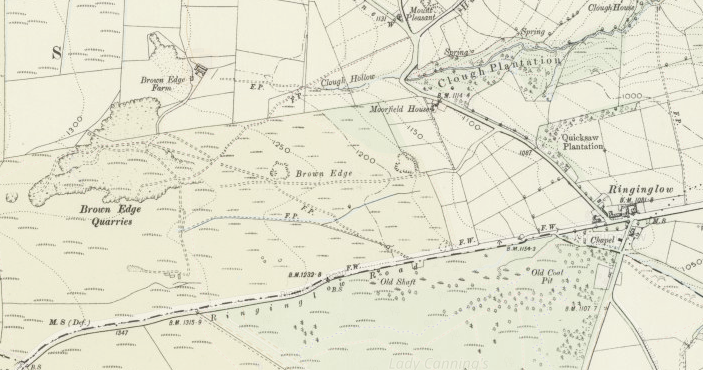
After our evening meal of fresh pasta, salmon and asparagus, I settled down to do a bit more research on the features I described up at Ringinglow. No solutions were found but here's a snip of the Ordnace Survey map of 1888:-
The mysterious "channel" is still there and so is the circular zone. I have read of an ancient burial mound beneath a large cairn west of Ringinglow though its exact location is today uncertain. Might it have been up there at Brown Edge? It's possible.

Sometimes mystery is more pleasing than explanation.

9 May 2020

Mystery

Just to the west of this city, near Ringinglow, I observed a couple of mysterious features in Ordnance Survey mapping. Bang in the middle of this snipped map there's a double banked channel and at its western end a curious circular feature. There is no suggestion in the map that this channel was connected with natural drainage from the moor.

I went to investigate and came away not much the wiser. It was hard to tell if the marked channel was connected with water. Perhaps it was a roadway. When it was constructed I have no idea. Perhaps it is ancient or it could simply have been made during the eighteenth century in connection with a big stone quarry that sits to the left. Can you see the "...ries"?  It's the end of "Brown Edge Stone Quarries".

This quarry was for the extraction and shaping of  stone roof tiles which were used widely in the region before much lighter and thinner Welsh slates were imported. At Brown Edge there was a big and uncommon outcrop of layered gritstone - perfect for roofing.

When researching the double-banked channel I thought it might have simply been a lane from the quarries but there's no reason why it should have been sunk into the landscape - no doubt after countless man hours of earth movement and digging. I am really none the wiser but I judge that the hollow was once a pond  because of a small conduit that cuts into the moorland depression.

History can be so slippery and in this instance I am not hopeful that any archaeological work has ever been undertaken to answer my questions. I will keep looking. 

Sorry if you found this blogpost tedious.
Circular hollow shown on the map with Brown Edge Farm beyond
The banked channel feature to the east
The banked channel feature to the west near the circular hollow

8 May 2020

Crémant

I do not know a lot about wine and before I embark on this short blogpost I shall proffer apologies for my ignorance to any Francophiles who are reading this - such as Cro Magnon or Susan in Glentham, Lincolnshire.

Let us think about champagne. I am sure that nearly all readers will be aware that the term "champagne" is reserved for sparkling wines produced in the Champagne region of France using the méthode champenoise. 

In my life I have drunk many awful glasses of champagne - usually at weddings but some thirty years ago I tasted an expensive champagne that was just heavenly. It knocked me for six. Suddenly, I realised why there was so much fuss about this beverage. Bubbles bursting in your mouth with just the right level of sweetness and so light. Like a happy summer's day.

Sadly, really good champagne comes at a price that is slightly prohibitive for everyday consumers.

However, a few months ago I was listening to a food and drink programme on BBC Radio 4. The wine enthusiast on the show explained that though champagne can officially only be created in the Champagne region, nine other regions of France produce almost identical sparkling wines using the méthode champenoise. These wine regions use the alternative term "Crémant". Usually such wines are a hell of a lot cheaper to purchase than champagne just because of the name thing.

That piece of information stuck in my brain and I have since bought and drunk three different bottles of "Crémant" from our local Lidl store at just £7.99 a bottle. We have tried "Crémant de Bourgogne", ""Crémant" de Loire" and ""Crémant" d'Alsace". They have all been delightfully palatable.

If like me you also enjoy good champagne, please give "Crémant" a try. Connoisseurs say that the best "Crémants" are easily as good as or better than your average champagne. Having supped three bottles I can heartily agree. The one I enjoyed the most was from the Bourgogne region - a deeper more honeyed version of the drink.

7 May 2020

Flytipping

In Britain, we use the word "flytipping" to describe the illegal dumping of rubbish - often in the countryside late at night. Fortunately, the people who do it are few and far between. The rest of us shake our heads in despair. How could anyone be so terribly antisocial, caring so little for the local environment? And who the hell do they think is going to clean up their mess?

Yesterday, as I walked for six miles  across a pancake flat landscape in bright May sunshine, I came across several saddening examples of flytipping. As well as the old tyres and disused gas cylinders in the picture above, I saw fridges, sofas, mattresses, a broken shed, garden waste, builders' waste, a suitcase and old clothing. The detritus of modern living.  Some of it had even been tossed into drainage channels that criss-cross  the area. How can the selfish perpetrators sleep at night?

Putting that heartbreak aside,,, Near Maud's Bridge I illegally crossed the railway track to secure this picture of a tree in a potato field with wind turbines beyond. The locality is known as Nun Moors...
And here is the peaceful view westwards along the Sheffield and South Yorkshire Navigation Canal, seen from Maud's Bridge:-
Back in the town of Thorne, I noticed  interesting sculptural work on Travis's Charity School (erected in 1863). The artefact must have been added  in modern times - for its sculptor, Byron Howard, is, I believe, still alive and kicking. The building is certainly no longer used as a school. In fact, a little googling revealed that it is Byron Howard's studio. Not to be confused with the Disney animation director of the same name.
It was a splendid, non-taxing walk - mostly along single track country lanes. I hardly saw any vehicles - just a few other walkers and a handful of cyclists but at Thorne Number 2 Level Crossing the red lights began to flash and moments later a short local train flashed by in an instant on its way to "Sunny Scunny" (Scunthorpe) in North Lincolnshire.

6 May 2020

Bird

Still alive
Yesterday I wished that I was Jesus. If I had been Jesus I would have breathed life into the little bird that I found thrashing about pathetically in the street after I had just delivered two coronavirus masks to Ronny and Margaret on Gisborne Road.

I went into our house and found a brown paper bag. Obligingly, the distressed bird popped into the bag and I gently carried her home to our back garden. What could I do? After all, I was not wearing long flowing white robes with a halo hovering a few inches above my head.

The little bird was still moving, apparently dazed. Her  stubby beak looked injured to me. There seemed to be a little blood. I sprinkled some water on the grass beside her and put a bucket over her - believing that a few minutes in darkness might reduce her stress.

Optimistically, I imagined that when I lifted the bucket she would simply fly away - no longer stunned. But as feared, the opposite was true. Half an hour after finding her on the tarmacadam she was dead.
I carried her lifeless body to our garden table and examined her. What kind of bird was she? I opened her wings and noted the wonderful arrangement of her feathers. She was a marvel of evolution - like all creatures.

As I have said before, I love birds but I am pretty hopeless at identifying them. I took a few photos of the corpse - hoping to use Google imagery to identify her later on. And as evening fell, I buried her at the top of the garden - making the hole quite deep in case a passing fox or cat fancied a tasty late night snack. Like a crazy fool, I placed a piece of chalk from Flamborough on her grave and a couple of daisies but I did not sing "Rock of Ages" or "Abide With Me".  It was most assuredly a non-religious ceremony. Sorry Jesus.

My WWW detective work suggests that she may have been a female chaffinch - far less flamboyant than the male of the species. The stubby beak seemed to give her identity away. However, I freely admit that I may be wrong and will be happy to be corrected. Sparrow beaks are definitely not like that.
Ten minutes after death

Most Visits