8 April 2022

Conisbrough

By The River Don at Sprotbrough 

The Lone Ranger and Silver were reunited today. For my first proper walk since COVID mugged me, Clint kindly carried me to Conisbrough this morning. It took forty minutes to get there. Clint insisted that I should park him in the little car park at the railway station and I duly complied.

There I donned my walking boots and set off over The River Don, soon crossing what was once a coal mining landscape and then over The River Dearne which meets the Don just west of Consibrough. I met two women on the footbridge over the Dearne and one of them said I sounded like the poet Andrew Motion though I think she meant Simon Armitage - every word measured and weighed.

Fresh sycamore leaves in the spring sunshine

Then onward to Denaby Ings. I like the word "ings". It is used more commonly in Yorkshire than in any other English county. The term is of Norse origin and refers to water meadows, marshes or land that is often flooded. Ings are frequently associated with wild birds.

The lane to Cadeby was about a mile in length and I had to be alert to motor vehicles as I hugged the narrow verges. Not much traffic passed by but enough to keep me on my toes.

St John the Evangelist Church in Cadeby

I didn't know what I would make of Cadeby but it turned out to be a very charming little village with around two hundred inhabitants. There was a lovely church and even  a pub-restaurant and though there were some modern houses they blended in nicely with the older stone properties. It was off the beaten track but only six miles west of Doncaster.

I continued to plod feeling perhaps uncharacteristically weary - the after effects of COVID I should think. I reached "The Boat Inn" at Sprotbrough where I ordered a refreshing pint of bitter shandy before carrying on between The Don and Sprotbrough Flash - a still lake and nature reserve that sits parallel to the river.

Up ahead an impressive railway viaduct came into view. Disused nowadays, I hadn't expected it to rise so high above the river valley. Lord knows how many bricks had been used in its construction - many thousands I am sure. I spoke to another lone rambler and he confirmed that I could walk over the viaduct. We crossed it together sharing friendly conversation. He had been born and raised in Conisbrough but now lives twenty miles away, close to where Shirley grew up.

Old railway viaduct over The River Don. A number of suicide jumps have 
happened here. The keep of Conisbrough Castle is visible on the skyline.

After the viaduct it was only a further mile and a half back to the railway station where Clint was snoring in the lengthening shadows of the green pedestrian bridge over the railway lines. I climbed into the saddle and called out "Hi-yo, Silver, away!" before galloping of into the sunset. Well, to tell the truth, there was no sunset at four thirty in the afternoon but it sounds better that way.

A view of Denaby Ings

6 April 2022

Woodrow

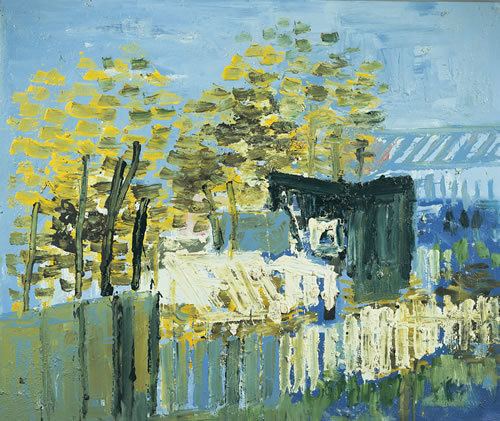
Joash Woodrow (1927-2006) could have easily been quickly forgotten when he died in a Manchester nursing home. It was by pure chance that his rich artistic legacy was discovered. He created hundreds of paintings but they were never seen by others - never sold and never exhibited. They could have all so easily ended up in a skip (American: dumpster).

He lived reclusively in his parents' home in the Chapel Allerton area of north Leeds. Before and just after World War II he received  good formal training at Leeds College of Art and at The Royal College of Art in London. He knew what art was and what it might be.

Some time thereafter he appears to have suffered a nervous breakdown and spent the next five decades painting furiously and passionately but without the sustenance that other artists might provide. He didn't even have a telephone.

His brother Saul tried to visit him every week but never got to see any of the pictures that Joash had created. It seems that Joash Woodrow made art because he was driven to do so. It was the art that mattered, not what others might think about it.

After Joash went into care, Saul delivered a huge collection of art books from the old family home to a local secondhand bookstore and that's where several were spotted by another Leeds artist called Christopher Wood.  They included many overpaintings and drawings by Joash Woodrow.  Wood alerted a gallery owner from nearby Harrogate who effectively saved the collection from destruction.

Exhibitions of Joash Woodrow's work happened before his death and some paintings were sold but he never knew about this as his last three years were spent in a kind of mental incarceration and perhaps Saul  remembered that his brother had never actively sought acclaim.

Untitled and undated but just for a small taste of him, here are four examples of Joash Woodrow's art as discovered in his house in Leeds:-

A preparatory sketch


5 April 2022

Netflix

Olivia Colman in "The Lost Daughter" (2021)

There's a lot of dross on "Netflix". On more occasions than I can calculate, I have begun watching films via "Netflix" only to give up after ten minutes or so.. Too predictable. Too amateurish. Too bloody boring.

Nonetheless, having also had some really good viewing experiences courtesy of the viewing platform, I knew that it contained some gems. It was surely just a question of rooting them out - like picking over a skip filled with rubbish (American: dumpster).

Rather than going straight to "Netflix" on our television, I decided to do a bit of googling - seeing if I could find a bunch of independently recommended films that might appeal to me.

That's how I chased down "The Lost Daughter" (2021) and "The Master" (2012).

"The Lost Daughter", directed by Maggie Gyllenhaal is set in an Italian summer and stars Olivia Colman as Leda. There are psychological undercurrents linked to past events and the air is heavy with "if only's" and "what might have beens", guilt and uncertainty. Things are not spelt out. You have to make assumptions and your own conclusions. What did it all mean? Olivia Colman was as brilliant as she always is, again demonstrating her incredible range as a film actress.

"The Master" focuses upon two men. There's Freddie played by Joaquin Phoenix and Lancaster Dodd played by Philip Seymour Hoffman.  Freddie is an alcoholic and troubled World War II veteran. He has demons to battle. Dodd is a clever charlatan and pseudo-intellectual who has harnessed the power of his personality to lead a semi-religious cult that is often referred to as "The Cause". There may be deliberate echoes of the growth of Scientology. He gathers people around him, including Freddie. Perhaps typical of cult leaders, Dodd often seems to believe in his own fiction.

Both films held my attention throughout. Neither was made for easy entertainment. They were well-crafted and clever and they were not filled with the sound of guns or the sight of gratuitous murders as many films are. They were both about imperfect people and how they relate to one another, what they learn and where their journeys lead. I like films like that.

Joaquin Phoenix and Philip Seymour Hoffman in "The Master" (2012)

4 April 2022

Poem

Street Art in Cardiff                                                                    © Gareth James 2022 (Geograph)

Ukraine April 4th 2022
 
The names are familiar now
Like echoes from history
My Lai, Guernica  and Oradour-sur-Glane
Rolled upon the tongue
Like boiled sweets
Found scattered in the streets
Of Kharkiv,  Bucha and Mariupol
“There are no threats to the civilian population”.
 
They staged it all
Those damned “khokol”
Brought in Hollywood set designers
Fake bodies, fake car wrecks
Fake apartment blocks blown to smithereens
Fake tanks abandoned at fake roadsides
Fakery is all…
“There are no threats to the civilian population”.
 
Checking his hair
The tyrant seethes in his lair
Ineptitude and lies lurk everywhere
Fists beat the desk like a drum
Praise to old times and fading glory
Let us resume our epic story
And remember
“There are no threats to the civilian population”.

3 April 2022

Heir

It cannot be easy following in the footsteps of a famously talented and fabulously rich father or mother. The strong likelihood is that no matter how hard you strive, you will never surpass the dizzying heights of your parent's achievements. You probably won't even reach the foothills of that particular mountain. Okay, there are exceptions to this rule but in general the point I have made is surely valid.
Above - who is that walking down a posh London street in  his Jesus sandals? I wonder what is in his plastic carrier bag? Have you got no idea? Look at his face. Does it remind you of somebody who made it big in the music industry?

I am not going to tell you who it is. If you cannot guess correctly, maybe you will have to do a right click and go to Google Image Search.

Perhaps it is daft of me but instinctively I feel sorry for that guy - despite the fact that in the course of time he and his siblings will inherit an absolute fortune thanks to his father's stellar career.

2 April 2022

Refrigeration

Many of the things that I witnessed on the island of Rotuma between 1972 and 1973 have remained with me.

There was no island-wide electricity supply. However, it did have a tiny hospital staffed by one doctor and one nurse. Because they had to keep many of their drugs, ointments and serums cold, they needed a stand-alone generator for their fridge. It also powered  hospital lighting for a couple of hours at night and allowed reliable illumination of delicate operations.

Now, because there was no electricity, there were no domestic refrigerators in which to store meat or fish. Sea food had to be eaten soon after it was caught or it would simply go rotten and become a health hazard. After all,  Rotuma is located in the sultry tropics, halfway between The Equator and The Tropic of Capricorn.

For most islanders, eating meat was a rare treat. Small herds of pigs were reared in the bush and generally fed on coconut meat and vegetable peelings and whatever they found by rooting around. There were hardly any cattle but many families kept a few hens both for eggs and the pot. If a chicken was killed it was soon plucked and gutted and cooked.  There were no fridges in which to put leftovers for later or the next day.

One day, there was great excitement. A cow was to be butchered in our village. This was to happen in the relative cool of the night.

It was duly tethered and shot in the head as its throat was cut.  Then the butchering began. An older man from another village had been brought over to lead this process. It happened on a bed of banana leaves under hurricane lanterns. At first the carcass steamed as the hide was removed. There was the noise of slicing and cutting and raised voices that I didn't understand but it was an unusual event and there was much excitement.

Meat was weighed and wrapped into parcels. Men on puttering mopeds took orders away to other villages as the residents of Motusa walked home with their bundles of fresh beef. By daybreak the job was done. I have no idea what they did with the bones but they would not have been wasted. Local dogs feasted on what was left as dawn bled into another bright morning.

That day, in many homes, islanders tucked into beef stews or strips of grilled beef. By Monday all of the beef would have been consumed because, as I say, there was nowhere to store it safely.

This brings me to my main point. Here in the western world we have become used to the possibility of eating meat or fish every day but when you think about it that is entirely down to refrigeration. Ships bring frozen lamb from as far away as New Zealand and Argentina. Modern supermarkets have chillers and freezers and nowadays  every home in the land has a fridge and maybe a freezer too.

We take these things for granted  but it wasn't always the case. For most of our forebears, eating fresh unsalted meat was an intermittent treat. It did not happen every day. In that sense, they had a lot in common with Rotuman islanders.  Refrigeration has had and continues to have a massive impact on our eating habits. It is an impact that has only really been felt for the last one hundred years. Before that it was all so very different.

1 April 2022

Fickleness

Our back garden at nine thirty yesterday morning

How fickle the weather is here on the island of Britain. You never know what you are going to get.

This past week is a good example. Last Friday, when I was rambling north of Castleford, I did so in a T-shirt and before setting out I applied sun lotion to my arms, face, neck and scalp. I would have been fine in shorts that day even though I have noted that exposure of my muscular legs  often causes passing women to swoon.

It was like summer that day and so was Sunday when I took those daffodil pictures. However, by Wednesday the main weather source had shifted to the north and there was now a distinct chill in the air. I sang to myself:-

The North wind doth blow,
And we shall have snow,
And what will poor robin do then, poor thing?

And sure enough as eggs is eggs, winter re-emerged yesterday morning. This was the scene from our back door at eight o'clock:-
And here was Clint tucked up close to our front bay window:-
He shivered and grumbled, "Why didn't you leave me at that nice garage? I was warm there!"

And here are the same daffodils I showed you last Sunday. Poor things:-

Many Britons grumble about the weather on our island but I like its unpredictability, its fickleness. That characteristic seems to reflect the human condition itself - that uncertainty, that sense of jeopardy, taking the rough with the smooth. And of course the extremes of weather are almost never experienced here. We inhabit a temperate zone.

Most Visits