16 March 2011

Survival

Last weekend I went to a cinema complex in northern Bangkok - ten minutes walk from my accommodation - to see "127 Hours". Directed by Danny Boyle, the film tells the story of a few days in 2003, when a young American outdoor enthusiast called Aron Ralston was exploring Blue John Canyon in a remote part of Utah. Accidentally, he tumbled down a crevice in the rocks where his right arm became trapped by a large rock he had dislodged.

As the hours and then the days pass by, Aron becomes more and more desperate to escape from this unfortunate situation. He sees visions of his family and of himself when he was a little boy. His water canister is empty. What can he do? Gradually, the inevitable dawns upon him - he must sever his arm with a useless Chinese knife his mother bought him for Christmas or he will die.

Ralston's part is played brilliantly by James Franco. In some senses, the tale might seem difficult to transfer to a movie format but Danny Boyle's creative vision is gripping, enhanced by wonderful cinematography and sound. At its heart there is the true life story of a man whose eagerness to live gave him the strength to administer a self-amputation without anaesthetic. Perhaps we might conclude that the moral of the film is that where there is a will there is a way. No matter how awful the circumstances, if you really want to survive you will find a way.

However, that same day we all heard about the dreadful events in northeastern Japan. I very much doubt that any of the thousands who have died there would have been able to relate to the possible moral conclusion of "127 Hours". When a tsunmai or a powerful earthquake come to get you, your hopes and dreams shrink into nothingness and there is no escape. As George Alagiah said on the BBC World News - the events in Japan remind us how ultimately flimsy and fragile is this "advanced" technological world that we have created.

But for me "127 Hours" was a super film and if you like that sort of tale, I would thoroughly recommend it.

13 March 2011

Bombay

Above you can see our lovely friend Moira - when we visited Santiago di Compostela in north-western Spain with her and her husband Steve, a retired fifrefighter. Moira recently started following my blog and I know she will be very surprised to see this post. Steve and Moira are presently in India. They touched down in Bombay (I refuse to call it Mumbai) and she emailed her first impressions to several friends. Moira is an incredibly fast typist. After all, this is something she has had to do most of her working life. That factor helps to explain the rapidfire, gushing nature of her account which I find a fascinating, unfettered piece of "stream of consciousness" writing which really captures a westerner's initial view of what must be a crazy, alien and overwhelming metropolis to encounter, full of sights, sounds, smells and human energy. Here it is:-

hello all !
arrived safely mumbai airport ... then hour longish taxi via mad mad mad bonkers traffic ..... horns go allllll the time ..... you take your life in your hands (literally !! ... rob why didn't you mention this !) ....when crossing the roads ..... however seen no one run over yet although 2000 homes have just burnt down in one of the shanty towns ! how the fire engine would get there i just don't know .... talk about a culture shock .... however blending in a bit more now, beginning to get the hang of things a bit/how folk work ! my red hair seems to draw attention from a lot of children ! hotel we have been in fine-ish ..... big holes in the sheets .... rather a yuk toilet .... waaaah .... but loads of hot water ... and extremely friendly/helpful proprieter, Raj .... (hotel moti international .... just near posh-ish hotel The Taj ..... which we couldn't afford ... ! which is just more or less next door so we are sort of with the posh folk !! ??) The gateway to india is about five mins away <>>>> so hot don"t want to eat much<>>> expensive for backpackers like you >>>> and us !) ..... not getting too harrassed ..... off to goa on early train in the morning 12 hours long journey then onto hampi .... then kerala all being well ...... just about to go and eat somewhere ..... first meal we had cost about two quid all in ..... though there are some more expensive places that a lot of folk go to .... rob ... been in mondegar cafe too a few times for breakfast .... near regal cinema ..... been in musem and art gallery but will be glad to move on from mumbai as soosooooo crazy/frantic/traffic amazingly never ending ever ever ever .....where do all the people live ?? ... a place all should come to once .... a couple of ozzy girlst told us they'd just come from delhi and think mumbai is laid back compared to there !! oh my god i don't think i'd be able to take it !! they say mumbai not as much in y'face ..... everyone seems to be in y'face here!!!! but no, not really that bad .... just biggggg culture shock .....but we are quickly adjusting to what's what ..... righty ho all,

11 March 2011

Psychology

What we remember from our childhoods may simply be psychological signposts to the kinds of people we really are. We don't choose what we remember. So much filtering of memory occurs, till in the end, bobbing on the surface, there's just a relatively small amount of flotsam with the mother ship far below the waves.

I remember, I remember... every time I was physically punished during my own school days and connected with every one of these memories is an echo of the seething feeling of injustice that accompanied those incidents.

Press the rewind button. It's 1962. I'm nine years old. I am in the playground of the village school where my father is the headmaster. Another, older boy has brought a rubber tiger mask into school. He has put it on and he is chasing round the yard, deliberately scaring girls who are screaming. I am in a gang of perhaps six who accompany the tiger boy. It's fun and the girls' screaming is affected. Nobody is really scared.

Miss Ford is on playtime duty. She not only calls an end to the high jinx, she sends the tiger boy and his followers to the headmaster's classroom where we wait in line. He, my father, being supportive of his younger colleague, tells us off and instructs us to hold out our hands. He walks along the line slippering all of us with a black plimsol. It hurts but not as much as the sense of injustice I feel inside. What had we done wrong? We were just having fun. Years later Dad apologised.
Fast forward to 1966. By achieving such a high mark in the eleven plus exam, I have won a scholarship to Hymers College in Hull where the posh boys go. It's a fee-paying direct grant school but each year, probably to ensure some council funding, they allow some plebs like me to join their hallowed ranks. I'm in music with Mr Watson. The room is like a large chapel. We are sitting in rows listening to some rather tedious classical music - Rachmaninov. Behind me one of the posh boys begins to rock his table on the hollow hardwood floor. Mr Watson calls out "Stop that!" above the soaring violins but the rocking noise continues. With his black academic gown splayed behind him, he surges up my row, comes to The Pleb's desk and cracks me hard across the temple with his open palm. He explains himself - "I said stop it!"

My anger boils over. I yell in my best East Yorkshire brogue, "It wasn't me you bastard!" and exit stage left. I am blubbering with shame and hatred and an overwhelming sense of injustice. I want to kill Watson. Put my muddy rugby boots on and jump up and down on his oily head. "It wasn't me you bastard!" Later no more is heard about the incident. Watson sweeps it under the carpet as if it never happened and I am grateful that I got away with swearing at him. If music be the food of love, play on Rachmaninov!

Onwards and I am sixteen. I don't want to wear a school cap. I feel stupid in it and my head is so big they don't make caps to fit me. I ride to school from the countryside. Thirteen miles there and thirteen miles back. I'm the only Hymers boy on the bus. At home I am listening to Bob Dylan and Leonard Cohen, Sgt Pepper's and Donovan and I saw Judy Collins on "The Simon Dee Show" singing "The Circle Game" and I have smoked marijuana, been drunk, known girls and I'm interested in Trotsky and Seurat and "Oz" magazine, Hull City and the civil rights movement in the USA. And they want me to wear a cap! Black and red with the school badge in the middle. I mean..

They have warned me. But now it is too late. I am in the office of Harry Roach, the much-feared headmaster. He is holding a thin bamboo cane. The room smells of polish and chalk and fear. A clock is ticking. I notice leather-bound books on the shelves, a large blotter on the oak desk, boys outside on the rugby field. He is lecturing me but I am not listening because I know what is coming. He tells me to bend over. I hear the cane swishing through the air then it hits my buttocks - one - two - three - four - five - six in rapid succession. The pain emerges like fire. My rump is ablaze and Harry is puffing after the exertion. All I can feel is the fire. I am like a whipped dog. I stumble from that dreaded chamber and my deranged hymn-singing torturer, determined to leave his horrible posh school in the summer.

And there were other times which I will not trouble you with now. Admittedly, I was no angel. I am sure there were occasions when I deserved the punishments I received but memory has chosen to let those bits of videotape settle on the ocean floor. Yet that plimsol, that open hand, that cane - I recollect those moments as if they happened just last week, remaining unsure what this says about my psychology.

10 March 2011

Courtesy

Voices are rarely raised in Thailand. People communicate with each other in a quiet, courteous manner. It is the same out on Bangkok's busy arterial roads. Often there'll be three lanes of clogging traffic with drivers skilfully weaving in and out of their lanes to gain some forward motion. But nobody's honking. No fists are raised. No road rage boiling over. Just brightly coloured taxis, buses, limousines, battered old Toyotas in a traffic jam dance.

In the school itself, I have yet to hear a teacher properly raising his or her voice in anything resembling annoyance. There's no need to play that card because the students are calm, dignified, compliant and cheerful. They support one another. On Tuesday I read out Peachy's creative writing to her Y9 class and when I had finished, the whole class applauded spontaneously - not my delivery but Peachy's splendid effort. There wasn't a hint of irony in that applause. No surly, snarling, teenage cleverdickery - just smiling young people acknowledging their classmate's work. How very refreshing this is for me. Like a daily medicine.

And I love the way in shops or restaurants, the humble Thai greeting will often accompany transactions. Palms together, head slightly bowed, hands moving from heart to head - "Kop Kun Kap" - thank you. In the depths of a sprawling modern city, the character of old rural Thailand has not been forgotten.

7 March 2011

Kanchanaburi

A cacophony of sound. Yes that is what I heard as I put my head on the pillow at midnight in the Thai Garden Inn on the edge of Kanchanaburi. Frogs, cicadas, a distant rooster, night birds and a host of small insects whose names I couldn't possibly pronounce.

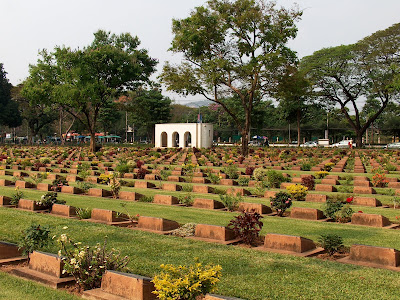
Kanchanaburi lies a hundred miles to the north west of Bangkok and is famous because the River Kwai Yai flows through it - under the famous Bridge on the River Kwai. I couldn't do everything in the thirty six hours I was there but I visited two war cemeteries, a large Buddhist temple complex and two museums that tell the story of the Japanese Death Railway. Between 1941 and 1943, 100,000 men died in the construction of this vital link between Thailand and the Burmese coast. Nearly seven thousand of them were young British prisoners of war brought up in cramped box carriages from Singapore and Malaya. Around 40,000 were Malays and a further 40,000 were Burmese. Many Dutchmen and Australians also perished.

The cruel single-mindedness of the Japanese seemed to know no bounds. Dysentery and cholera were rife. There were tropical ulcers and festering wounds. So many heartbreaking stories. Food supplies were paltry and equipment to drive the railway through the mountains was very limited - disposable human muscle power being the principal resource. At the Jeath Museum in the grounds of Wat Chaichumpol Temple, the visitor leaflet closes with these salutary words - "May Peace Always Conquer Violence".

Cycling back from Chungkai War Cemetery, I was startled by a six foot crocodile that had been resting in the grass at the side of the road. It made a swift beeline for the bushes. Later, I was surprised to discover that the Siamese crocodile is extremely rare - a truly endangered species. I guess it could have been a different kind of croc. It all happened so quickly. I'm just so glad it didn't choose to rear up from the tall grass and take a chunk out of my left leg! Sir Chris Hoy or Lance Armstrong never had such problems when cycling.

I swam dozens of lengths of the lukewarm hotel pool, separately met two people from Sheffield and had a whole riverside restaurant to myself as I ate a delicious Thai meal watching the swirling mountain waters flow past me. I rode back to Bangkok in a cramped minibus - £3 for the trip - and after battling through the city's eternal traffic jam I was deposited at a bus station just a mile from my serene guesthouse.

Walking across the Sood Jai Bridge, I had looked at the verdant river vista before me with distant and strangely shaped mountains beyond, shimmering in a haze of heat and had whispered to myself "Yes - this is really Thailand". A dragon boat had powered through the water as I had noticed a little palm leaf house in the shadow of the arching concrete. Here's my latest photo album:-
Dedicated to the memory of a random member of the British army: 996278 Gunner H.Heward who died on October 8th 1943 at the age of thirty one. How very different his visit to the River Kwai must have been. May he rest in peace...

4 March 2011

Schumacher

It was Wednesday February 9th, the day I was scheduled to begin my journey to Thailand. The flight was due to leave Birmingham at eight twenty in the evening. In recent years I have made several car journeys to Birmingham from Sheffield. It normally takes an hour and forty five minutes - M1, M42 and then A38 right into the heart of the city. No problem. And the airport lies to the east of the city anyway - meaning the journey would be even shorter

To be cautious, Shirley and I set off at just before quarter to four in the afternoon. We tootled along the Dronfield by-pass towards Chesterfield, possibly thinking that we hadn't needed to give ourselves so much time. We'd probably be there by half past five, ready to order a last supper with Frances who planned to come out to the airport by train from Selly Oak in Birmingham to see me off.

We sped along the A617 towards its junction with the M1 - Junction 28. And when we got there - yes, you've guessed it - the traffic on the southbound M1 was completely stationary - as far as the eye could see. Panic. I was going to head across to Mansfield and try to get down to Nottingham but Shirley mentioned Clay Cross and the A61 so I doubled back and, feeling not unduly concerned, drove over to Clay Cross, meeting the A61 at about four thirty.

Between Clay Cross and Derby there's a squat little former mining town called Alfreton, mentioned in some of D.H.Lawrence's writing and bang in the centre of this ugly town is a busy crossroads with traffic lights. Unfortunately, we weren't the only ones who were trying to avoid the M1 car park that evening and Alfreton was becoming not just congested but clogged up like a U bend filled with solidyfying fat. We found ourselves moving at a snail's pace. From Higham to Alfreton is little more than a mile but it took us almost an hour, so now it's just past six o'clock and we're miles from Birmingham. Could we make it? I was beginning to doubt it.

I had checked in online but I still needed to be at the airport ninety minutes before departure at six fifty. The race was on. Fortunately we breezed around Derby and hit the A38, driving as fast as I dared as we watched the minutes and the miles tick away. Shirley had kept Frances informed of our progress with one of those annoying inventions that Americans call "cell phones".

It was touch and go as the airport drew closer. After all, many people have missed flights because of road hold-ups and I thought that perhaps this was my time in spite of our early departure from home. Like Michael Schumacher, I skidded into the drop off zone of Birmingham International, hauled my bulging suitcase from the boot and dashed to the Emirates check-in desk. Amazing! Just in time - by the skin of my teeth!

And there was Frances! Little time to talk. Just hugs, kisses and a "Bon Voyage" card with three tiger cubs on the front. Then dashing through security to the departure gate, on to the plane to find that a creative writing student from East Anglia University, Norwich was in my pre-booked seat. Get out of there ye scallywag! I needed to catch my breath. Phew!

2 March 2011

Pens

In the autumn of 2003, I was lucky enough to visit Durban in South Africa with a group of Sheffield schoolteachers. One of my lasting memories is of the five days I spent at the Ogwini Technical School in the vast Umlazi shanty town on the southern edge of the city.

One day I had to teach a class of sixty Zulu pupils aged thirteen to twenty. The windowless room was chock-a-block. I asked them to write a letter to schoolchildren in England, telling them all about their lives. As they grafted away, you could have heard a pin drop. These were impoverished children from tin shacks. Most were barefoot. And you know what - every single one of them had a pen to write with!

And now here in Bangkok, I am teaching some of the sons and daughters of Thailand's aspirational and wealthy upper class. Once again every single child has a pen to write with. In fact here every child has pencils, crayons, highlighters, sticky tape, glue, erasing pens, scissors etc.. The idea of requesting a pen from a teacher is utterly unheard of.

Wind back to my working class Sheffield comprehensive school or "technology college" as they preferred to call it. There wasn't ever a lesson that began without a bunch of "students" requesting pens to write with. Often they would fail to hand these pens back. In other words they stole them. In my English department we tried letters home, detentions, fines, pen monitors, lists -whatever we could think of - but still a hard core never brought pens or even carried schoolbags. There were 870 children in the school and in my last year I had to order some five thousand cheap black ballpoint pens

You had the mentally certifiable headmistress claiming it didn't matter - we had bigger things to deal with - oh, and by the way, could we ensure that homework was set each week and where's your action plan for next term? All those computers, those career lessons, all those highly paid teachers and ancillary staff and yet sometimes I felt that my English colleagues and I were the only ones who understood that having a pen was a symbol of intent as much as anything. Without a pen, children were simply sticking two fingers up at the system, declaring they didn't really give a damn. It was a contagious disease.

The children of Ogwini, like the children of St Stephens Bangkok, prove that I wasn't mad or unreasonable to expect pupils to be responsible enough to bring pens to school. This is something that will never make newspaper headlines but it demonstrates that the pompous, conference visiting, expenses-claiming, back-slapping gobs-on-legs who preside over England's education system will frequently fail to see the trees and the bushes that make the wood.

Most Visits