4 April 2017

"Parade"

Sometimes one's blog can function like a confessional. Oh, bless me father for I have sinned!

I press the re-wind button and my life flickers by in reverse until we arrive at 1966. 

I am a schoolboy aged twelve. Every morning I ride the East Yorkshire Motor Services bus into Hull and ride home in the afternoon - a total round trip of twenty six miles. This was the dubious reward I won for passing the 11+ examination with flying colours.

At school, the masters wear black academic gowns and the headmaster is a fearsome fellow called Harry Roach. He struts onto the stage every morning to lead the daily assembly while I linger in the corridor with the Jewish boys because I arrive late every day. When the religious stuff is over we filter into the back of the hall to hear the day's notices. There are rugby results, details of extra-curricular activities and ominously the names of boys that Harry wants to "see" after assembly. "See" means "cane" with a bamboo rod. We all know that and fear being thrashed. In caning, Harry is an Olympic champion.
A back copy of "Parade" from the 1960's
showcasing a guitar virtuoso on the cover
I am learning Latin, French, Chemistry, Physics, Biology and something called Divinity which is incredibly boring and always focused on the Christian Bible. There's also History, Geography, Art, Woodwork, Mathematics, Music, English and on Wednesday afternoons - rugby - a "subject" in which I quickly begin to excel.

But in my head there are other things going on. Secret things and novel urges I had not experienced before. Another boy shows me a secondhand copy of a "dirty" magazine called "Parade". We thumb through it together in the cloakroom and my eyes pop out on stalks. Looking directly at us and smiling knowingly, there are lovely young women with their breasts exposed. Overlooking my babyhood, they are the first breasts I have ever seen and I like them. I like them very much indeed.

My lusty  companion explains where he bought his copy of  "Parade" and one lunchtime the following week I make a special trip to a seedy old bookshop on Spring Bank. I see the pile of back copies of "Parade" near the door - just where he said they would be. Plucking up courage, I grab the copy that's sitting on top of the pile and bravely part with a shilling. It is such a relief to get out of the shop but I have my very own "Parade".

In the weeks that follow I turn those pages a thousand times. The readers' letters are interesting but it's the pictures I like the best and it's there that I linger. If only I could put as much commitment into my Latin homework. I seem to recall that there was a particular dark-haired beauty called Sharon Powers. In my imagination we become lovers, holding hands on country walks before rolling around in haystacks. She looks up from the page as if she recognises me. It's our little secret.

Nowadays youngsters find it easy to access hard-core pornography on the internet. Any age restricting defences are cursory and simple to circumvent. Puberty has always been a time of discovery, leaving childhood innocence behind and the awakening of sexual interest is perfectly natural. However, I am glad that back in 1966 we didn't have access to pornographic films, just mildly raunchy publications like "Parade". I kept my copy in my satchel before sneaking it under my mattress at home which is where my mother discovered it when changing the sheets. Did she have to rip it up and burn it on the fire? Poor Sharon and the other girls - it was a horrible way to go.

3 April 2017

Trees

Surprisingly, Sheffield is the greenest city in Great Britain and one of the greenest in Europe. If you could view the south of the city from a summer sky you will be surprised by how many trees line our streets and valleys. This should be one of Sheffield's proudest boasts, along with the fact that football was invented here and yet the city council seems determined to keep such information secret from the rest of the world.

Living in modern times we are meant to pay homage to free trade and private enterprise. Cash-strapped city councils have had to farm out services to private companies. In Sheffield, the maintenance of our streets used to be the sole responsibility of the council's Works Department but nowadays it is mostly undertaken by a private profit-oriented company called Amey. With massive government funding they are currently involved in a long term project known as "Streets Ahead" - supposedly to improve the urban environment.
As a feature of their "Streets Ahead" scheme, Amey have been chopping down a lot of mature trees, claiming incorrectly that they are all dangerous and diseased. In place of these lovely green giants they generally plant puny little saplings which are staked to the ground and would take many decades to mature into lofty trees if indeed suitable varieties were being selected.

There have been many protests about the felling of our trees. Some people have been arrested and many trees earmarked for destruction have been dressed in yellow ribbons and protest posters. Often Amey have arrived unexpectedly  to chop down trees in the early hours, disturbing residents and arranging costly police protection ironically at council tax payers' expense. To me the bottom line is that Amey are not keen on pollarding our mature trees or pruning them. This process can be quite costly and of course such annual servicing would reduce Amey's profits.

Last night, when knee pain disturbed my sleep, I had the idea of writing a protest poem which I plan to send in to the local newspaper - "The Star". Perhaps they will publish it and it will add a little extra support to the campaign to save our trees. Anyway, just this morning, I wrote it instead of taking a shower. Here it is:-
_____________________________________________________

City of Trees

From above, the city looked green
So many trees - such a marvellous scene
Trees to filter the fumes from the air,
Arboreal beauty everywhere.
Our City  of Steel was a City of Trees
With songbirds hidden amongst the leaves
Then Amey arrived with their corporate silence
Basing decisions on  pseudo-science.
To pollard or prune would reduce their profit
Though tax paying Sheffielders cried “Come off it!”
The vandals arrived in  the early morning
Dressed in hard hats without any warning
With safety glasses that hid their eyes
And Hi-Viz hoodies to complete the disguise.
On their backs they’d stamped “Streets Ahead”
But surely  this legend should have read
Something different like “Streets Behind”
For such was the vision they had in mind
A city of saplings and wooden stakes too
Bashed  into our streets where giants once grew.

2 April 2017

Riverside

View to The Humber Bridge from Hessle foreshore
After the football match I got on board a double decker bus with my old friend Tony and we travelled back to the "Park and Ride" at Hessle. I should have just got on the A63 ready to speed home but on a whim I took a side road to the foreshore of The River Humber where I snapped the accompanying pictures:-
Looking across The Humber to New Holland in Lincolnshire
Old mooring chain near Hessle Haven
Looking along the Humber shore to the chemical works at Saltend
And then I was back in the car speeding home to Sheffield - a journey I have undertaken many times but always sweeter when my team has won. The A63 merges with the M62. Then it's over The Ouse Bridge near Goole before branching off  along the M18, past Thorne, Doncaster and the A1 junction to the M1. North along that road for two miles then left down the Sheffield Parkway. I could do it with my eyes shut.

Back home my faithful spouse had prepared a comforting cottage pie with garden peas and gravy. A suitable celebratory meal for a hungry Hull City fan.

Winteringham

South of The Humber. This was the point where Ermine Street arrived at the great river estuary. Ermine Street was an important artery in Roman Britain. It led from Lincoln (Lindum) to York (Eburacum) but in between was the  shallow tidal river over half a mile across that lies beyond the reeds you can see in this picture. It is said that the Romans forded The Humber from this point... or perhaps they used simple boats too. There were soldiers, builders and merchants. Taking this watery route avoided a forty mile detour. I think The Humber would have been shallower in those days with no dredging activity and perhaps there was a causeway of branches and reeds to make it easier to pass over the river mud at low tide, Today it seems almost outrageous that fording happened from here for four hundred years. The Humber is so very different from a babbling mountain stream.

I stopped here before heading over The Humber Bridge to watch Hull City beat West Ham United 2-1, adding extra hope to the possibility of remaining in England's Premier League.

30 March 2017

Hockney

Last Friday night we had tickets for the Hockney exhibition at Tate Britain. There was me, Shirley, Ian, Frances and Frances's boyfriend Stewart. Beforehand we enjoyed a great Indian meal at a restaurant on Vauxhall Bridge Road - "The Millbank Spice". Yummy and not too expensive for central London.

And then Mr David Hockney was waiting for us. Born in Yorkshire in  1937, he has spent sixty years creating art and is still doing it. The exhibition demonstrates the different phases Hockney has been through - forever evolving, finding new things to "say" through his artistry while sometimes pausing to explore favourite themes such as Californian swimming pools or little travelled lanes in the Yorkshire Wolds.
"Going Up Garrowby Hill" by David Hockney (2000)
I remember a BBC interview in which Hockney declared that throughout his career as an artist he had only ever "done" what he wanted to do. He wasn't a follower or a conscious mimic and nobody ever controlled him. He only accepted commissions that he felt enthusiastic about. Not many artists can honestly claim such independence and creative integrity after so many years of making art.

I loved it all - the pencil drawings, the use of crayon, the charcoal, the pastels, the swimming pools, the homo-eroticism, the faithful portraits of friends, the pop art, the acrylic perfection, the masterpiece that is "Going Up Garrowby Hill". the i-pad sketches, the photographic mosaics. You were looking at reflections of our post war world seen through the eyes of a fallible genius.

It's fascinating that well into his seventies Hockney became absorbed by The Yorkshire Wolds - a subtle rolling chalk landscape with which I am very familiar. The icing upon the exhibition's cake was arguably in the penultimate room where the four walls hosted banks of video screens upon which images moved gently - images of Woldgate Woods in the four seasons. It was hauntingly beautiful and somehow spiritually  therapeutic. 

Though a few of his finest pictures were missing, I felt that Tate Britain had done a brilliant job in showcasing David Hockney's work, providing more than enough evidence to confirm his greatness.

28 March 2017

Pictures

A selection of photographs I snapped during our very long weekend in London. Actually, it's also a kind of quiz for your delectation. Each picture is numbered. At the bottom there are five captions - all lettered - but can you work out which picture goes with which caption? It is an intellectual challenge that might have even defeated Albert Einstein!
Picture 1
Picture 2
Picture 3
Picture 4
Picture 5
Captions
A Egyptian geese and goslings by Tooting Common Lake
B Refreshing and expensive drinks on the 33rd floor of The Shard
C Ian and Shirley at Leicester Square tube station after we had been to see "The Lion King"
D Tourist writing home in the courtyard of Somerset House
E Elizabeth Tower (aka Big Ben) seen through The London Eye

Drama

Conleth Hill and Imelda Staunton as George and Martha
Four days in London. Sorry I was out of action in blogging terms for I just couldn't get on with my daughter's Apple laptop. Anyway, suffice to say I am back in Yorkshire with various blogging ideas I could develop in order to bore you to death. Be warned.

For this post, I am just going to report back on "Who's Afraid of Virginia Woof?" by Edward Albee. It is currently being staged at The Harold Pinter Theatre off Leicester Square. It's a play I studied and wrote about when I was eighteen years old but I hadn't seen a live performance of it until Thursday night. It was definitely worth waiting for this production. I had a great seat in the second row of the stalls. 

There are only four characters in the play - Nick, Honey, George and Martha. The latter role was played by Imelda Staunton. It would be easy to summarise the plot but you can find such  information elsewhere. Let me just say that it is a late night/early morning drama in which tongues are loosened as the four characters confront notions of truth and illusion. It is both intense and powerful.

At the end of the show, I was out of my seat applauding the faultless performance I had just enjoyed. Imelda Stanton and Conleth Hill (George) had both been brilliant, so engaged with their parts, appreciating the significance of every word they voiced. I got lost in the play, my inner thoughts reduced to naught. Bravo!

...But something else was happening. Just two seats further down Row B but also involving a group of theatregoers in Row C. Next to me in Row B were four men in the late thirties or early forties. As soon as the curtain went down for the interval an unholy row broke out between one of the men and the Row C people. 

It seemed that in the first half of the show some annoyance had been caused. I had been totally unaware of this but  one of the men was up out of his seat, bending his head towards the occupants of Row C, raising his voice and threatening them with physical violence. Reasonable protests emerged from Row C but they only added fuel to the angry man's fire. He sounded Russian or Eastern European. At one point he spat at two of the Row C people. It was rather shocking.

I deduced that the people in Row C had tried to shush this man during Act One. Apparently he had coughed a few times but I never heard this. I certainly wasn't aware of it. Even as the curtain went up for Act Two the angry man was still being loud and threatening but he went quiet as the show continued.

There was a short curtain break to alter the set between Acts Two and Three and again the nasty public row fired up. As I joined in the standing ovation after the final curtain it all kicked off once again but fortunately, as the audience departed, the Row C people sensibly went for a different exit, avoiding further confrontation. 

All of this was really quite bizarre. Luckily it didn't spoil my experience. It was almost as if the dramatic soul searching up on stage had spilt out into the audience. I was so glad that that angry man hadn't been venting his flame on me. I would probably have lamped him, yelling "Who's Afraid of Yorkshire Pudding?" before my inevitable arrest.

23 March 2017

London

Shirley and I are off to London this morning. We are going to see our children and to visit theatres in the West End. I have also bought tickets for the Hockney exhibition at Tate Britain. My mobility remains a problem because of my knee so I am somewhat anxious about  hobbling around. I will be looking to limit the amount of walking I have to do. Yesterday's visit to the doctor led to the collection of some heavy duty painkillers and the promise of an appointment with a physiotherapist.

But how could I tell you we are visiting London without reference to what happened yesterday?  As I sit here, the running BBC News programme is all about the Westminster attack by a wicked madman who no doubt saw himself as an Islamic martyr. May he rot in hell and may his name - soon to be revealed - be forever associated with evil. 

We go to our nation's capital, proud to be English and proud to be citizens of the free world. We shall not be cowed by vile nobodies like him or by others of his ilk. 

22 March 2017

Robocalls

Rrring-rrring! Rrring-rrring:! Rrring-rrring!

I pick up the phone.

"Hello,"

Nothing.

"Hello?"

Again nothing. Just an empty cave and the ghosts of electronic crackling.

There's nobody there because this is a typical robocall or what some people call a bot call.

I got one this morning at 8am and I received a similar call at a similar time on Monday morning. Generally speaking, I am a night owl. To use one of my late mother's expressions, you will often find me "raking around" in the early hours - painting foxes, watching "Democracy Now", reading books or blogs etc.. Consequently I often get up late  - around eight thirty or nine so you can imagine that  I am not at all happy about being disturbed by robocalls. After I have leapt out of bed to take the intrusive phone calls,, it is just about impossible to get back to sleep again. I wouldn't say such days are ruined but they certainly begin on a very unpleasant note having been deprived of my desired allotment of refreshing sleep.

It used to be that unsolicited phone calls and robocalls happened in the evening and it was rare to be hit by them in the morning but over the last few months I have noticed a growing incidence of morning calls. How long will it be before the scumbags who oversee these disrespectful systems start disturbing us in the middle of the night?

Please don't blame me. Like thousands of other people I am the innocent victim of robocalls. I have blocked several numbers and I signed up with the TPS (Telephone Preference Service) years ago. It's not my fault these calls keep coming.

You can't help wondering what on earth "they" are doing about robocalls. You know who I mean - telephone companies, governments, GCHQ, the FBI, The United Nations, the police, Interpol etc.. Surely in this day and age it should be possible to pursue the perpetrators of robocalls, rogue telemarketing outfits and other phone-line crooks - to stifle their unwarranted intrusions into law abiding citizens' lives.

21 March 2017

Vogue


People in high places with pressurised and important jobs need release valves if they are to stay sane. President Obama and the current occupant of The White House - whose name evades me - both like to play rounds of golf. Vladimir Putin lets off steam by wrestling bears or playing ice hockey. One former British prime minister, Edward Heath, liked to go yachting while another, Yorkshireman Harold Wilson liked to cheer on his beloved football team - Huddersfield Town or relax in his holiday home on The Isles of Scilly.

The late Colonel Gadaffi of Libya was interested in football, Beethoven and interior design while Adolf Hitler spent hours bouncing up and down on his pogo stick . (Pregnant pause)... Err, I must confess that I made the last bit up. The present political leader of Australia, Malcolm Turnbull likes to walk his dogs. Justin Trudeau of Canada likes a workout in the boxing ring or occasionally a visit to the local tattoo parlour

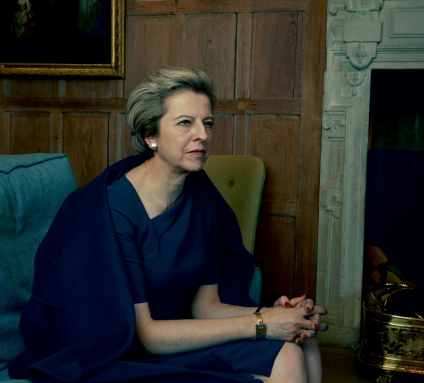
And so we come to Britain's current (unelected) leader - Theresa May. There she is in Westminster wrestling with the fallout from last year;s EU referendum and ostensibly trying to steer our country to the best deals she can. But of course, like all other leaders, she needs her escape activities. What does she pick? Perhaps a whist drive in the village hall or a game of bowls on the green?

Not on your nelly! Theresa chose to do a fashion shoot with "Vogue" magazine. Charitably, she was probably thinking - why should my husband Philip (a banker) be the only one to enjoy my modish fashion sense? As a British voter it warms the cockles of my heart to know we are now being led into the Brexit abyss by a fashion model. As  Madonna sang:-
Oooh, you've got to
Let your body move to the music
Oooh, you've got to just
Let your body go with the flow
Oooh, you've got to
Vogue
The delectable Theresa May posing for "Vogue"

20 March 2017

Lay-by


Please don't judge me but sometimes I like to drive out into the nearby countryside to find a quiet spot. There I will simply sit in my car for an hour or two and read which ever book I am on. I need silence and good light for reading - with no distraction. 


Yesterday afternoon, I was parked up in a remote lay-by under Stanage Edge reading "Shakespeare" by Bill Bryson. Finally, I finished it! Hurrah!  It was, after all, a fascinating, readable and well-informed look at The Bard's life, claims that have been  made about him and the very small amount of evidence for his existence that remains four hundred years after his death at the age of fifty two.

Bryson scorns ridiculous notions that Shakespeare was in fact someone else like Francis Bacon or Ben Jonson or even Queen Elizabeth I, pulling these self-indulgent and spurious arguments apart, like dandelion seeds. The book finishes with this sentence: "Only one man had the circumstances and gifts to give us such incomparable works, and William Shakespeare of Stratford was unquestionably that man - whoever he was."

As I as sitting in my lay-by, another car pulled up behind me. I looked in my rear view mirror and noticed that the front seat passenger had a huge red ball on his lap - either that or he was heavily pregnant. 

The occupants of the car - three men and a woman - clambered out with bags and coats etc.. Soon they were walking off along the drizzly country lane. It was then that I realised the red thing was actually a huge Angry Bird mask - you may have seen images of that popular computer game character.

They proceeded through a gateway and trudged three hundred yards or so across rough pasture to some rocks beneath Stanage Edge. As I had now finished "Shakespeare", I got out of my car and went over to the boundary wall with my camera. Using it's full zoom facility I snapped several pictures, including the two that follow this paragraph. What the hell was going on? Have you any idea?
P.S. I have at long last  made an appointment at the local health centre to see a doctor about my gammy knee and have stopped putting artificial sweeteners in my tea and coffee after reading that there may be a link between regular use of aspartame and the development of arthritic conditions.

19 March 2017

Masterpiece

Masterpiece? Well - it is to me. I have tried my best to produce passable pictures of foxes and this is the very summit of my ability. After all these foxes I shall move on to painting other subjects - like landscapes, human faces,  buildings or water. No more foxes. Actually, I have only been painting one fox - namely Fred Fox who was a regular visitor to our suburban garden as long time visitors may recall. I hope that this final picture has done him justice, capturing something of the plaintive, quizzical look he would often give me.

18 March 2017

Retrospective

Ten years ago on March 18th 2007, I published the following blogpost which I titled "Waiting". I was of course much younger then. Our son and daughter were still living at home. The term "Brexit" did not exist. I was still slaving away as Head of English in a secondary school - like a hamster on a treadmill. Hull City fans were still only dreaming of Premier League status - never thinking it would happen. My mother was still alive and so was Shirley's.

Times change. Things move on.

I rather like the punchline of this post. The idea that what truly matters in life is activity - the doing, not the waiting. I seem to do a lot of waiting these days. Perhaps we can't avoid it. Perhaps a life that was all doing and no waiting would lack contemplation or comprehension. Anyway, I hadn't looked at this post for ten years until this morning. Time to share...

____________________________________________________________
Waiting
Sunday afternoon – waiting for Shirley to come home from her trip out to Lincolnshire to see her mother on Mothering Sunday. Saturday night – waiting for the lottery results to tell me I’m free, waiting for a pint of ale at The St Patrick’s Night Party. What party? And why did Guinness boast that they’d produced three million green badges specially - along with one million of those dumb felt Guinness hats. Would St Patrick have admired such pointless waste of Mother Earth’s resources.? If put side by side in a line - those badges would reach from our house seventy five miles – right out into the North Sea.

Waiting for the years to pass. Counting the years on your mortgage, the years to retirement. Waiting for the weeks to pass – till the next holiday, the next birthday, the next anniversary. Waiting.

At the football waiting for the bus to come, waiting for the players to come out and at half time , waiting for them to return and waiting for the goal that sometimes never comes. Waiting for a season when we shine. Waiting.

Lying in bed listening to the wind, thoughts swirling in your head as you wait for sleep to come. And at work waiting for the clock to tick on to lunchtime or to the end of the day. Waiting for Easter. Waiting for Christmas. Waiting for a parking place. And we have sayings – Guinness again – “Good things come to those who wait”, “Wait a minute”, “Wait a little bit longer”, “Waiting for Godot”. And we have waiters and waitresses, people who wait on us.

But the best of life is when we are not waiting but doing. Living the moment, happy in the here and now, not wishing our lives away and waiting for something else, something beyond this moment. I’m a waiter and that’s my tip of the day.

17 March 2017

Background

How nice that some of you enjoyed yesterday's poem - "Daffodils".  It was inspired by the sight of a border of daffodils in our garden - all sunny and bright yellow in the sharp spring light of Tuesday morning. I wanted to write a joyful, celebratory poem in honour of those familiar heralds of spring. They remind us about renewal.

Of course it has been done before. I think everyone is familiar with William Wordsworth's  "I wandered lonely as a cloud" which was inspired by a walk he took by Ullswater with his sister Dorothy in the springtime of 1802. It is a poem I have read and considered many times. There is a sense in which Wordsworth's poem was not really about daffodils at all but about humanity's relationship with Nature. In the last verse, Wordsworth looks "upon the inward eye" where he finds contentment in his memories of Nature. This was a recurring theme in his work.
Picture used to accompany yesterday's poem
In comparison, my poem was far less profound. All I wanted to do was applaud the daffodils and note their welcome return. I had gone out into the garden with a bowl of seeds for the garden birds when I was suddenly captivated by our little border of yellow trumpeters beneath the privet hedge. How healthy and proud they appeared. I went inside for my camera.

It was Shirley who planted the bulbs there a few years back, just behind a clump of ferns which of course remain dormant till the early summer. The daffodils like it there, sheltered from northern winds in a little suntrap and by the time the ferns are pushing through, the daffodils are dying off, their goodness being sucked back into their subterranean bulbs. I suppose it is a symbiotic relationship.

In the poem, I deliberately used the word "fluttering" as a nod to Wordsworth's "Fluttering and dancing in the breeze". Near the end, I echo a joyful line from "Get Happy" famously sung by Judy Garland in the 1950 musical film, "Summer Stock". Popular culture and poetry have an uneasy relationship and I like to play around with that tension by referencing modernity. After all, this isn't 1802.

15 March 2017

Outskirts

Down south in London and thereabouts, most of the inhabitants have little appreciation of The North. They probably think of our great northern cities as sprawling, smoky hives of industry. Places where men wear flatcaps and walk whippets along cobbled streets while women peg washing on clothes lines strung between endless terraces of cramped houses and barefoot children play hopscotch or aimlessly kick balls against walls.

But UpNorth has delicious secrets.

Take this city for example - Sheffield. Once it was the world's biggest producer of steel. In the nineteenth century, its population grew from 46,000 to 350,000 as workers flooded in to work in the foundries, factories and finishing shops. But throughout that expansion the western outskirts of the city remained as beautiful as they are today.
Just a stone's throw away there are farms, babbling brooks, green valleys, drystone walls, wooded hilltops and country lanes that lead to wild moorland where grouse cackle and falcons soar. If you live in Sheffield it's easy to get away from things and be in Nature's soothing company. To reach such countryside would be a major mission for Londoners - involving long car journeys or public transport. But here in Sheffield it's right on our doorstep.

For your interest, here's a list of the city's western districts - Whirlow, Bents Green, Ecclesall, Fulwood, Crosspool, Lodge Moor, Nether Green, Broomhill, Loxley, Stannington and Middlewood. They all lead to the delightful outskirts of the city - sometimes referred to as Sheffield's "golden frame". 

The pictures were taken yesterday by your faithful correspondent on Brown Hills Lane just beyond Fulwood.

14 March 2017

Food

My meal at "The Rhubarb Shed"
Almost everybody in the world loves eating. Whenever I hear statements like "I love my food" or "She loves her food", I think - so what? It's hardly worth saying. For almost everyone, eating good or tasty food is simply one of life's great pleasures.

Trip Advisor doesn't only collate hotel reviews, it also encourages independent reviews about restaurants and other eating places. Then, using calculations of ratings received, it ranks these eateries in order of popularity for just about every town or city in the western world and beyond.

On many occasions I have referred to Trip Advisor before visiting restaurants and almost always I have found this guidance both accurate and extremely helpful. If Trip Advisor tells you a place is brilliant then it very probably is and if other reviewers say it's awful then that will also be true.

With regard to the city of Sheffield, Trip Advisor lists 1,196 eating establishments.  Currently, at the very top of the pile comes a humble cafe called "The Rhubarb Shed". It has attracted 147 reviews of which 132 have been "excellent" while the other 13 reviews were "very good". 
Approaching "The Rhubarb Shed"
I had been curious about "The Rhubarb Shed" for a while. It is located in one of the poorer parts of the city known as The Manor Estate but it is also close to the ruins of Sheffield Manor where Mary Queen of Scots spent a large period of her incarceration - from 1570 to 1584. 

Finally, Shirley and I visited "The Rhubarb Shed"  for the first time last Thursday lunchtime. It was very much non-corporate with a friendly, slightly chaotic atmosphere. As the cafe's name suggests, it was once a rhubarb shed where rhubarb was forced. There are seven tables downstairs and seven upstairs in the loft.

Shirley ordered a chicken wrap with salad and chips while I ordered a beef brisket sandwich on toasted ciabatta with salad and chips. It was simple fayre but very delicious, The chips (french fries) were especially yummy. We had a pot of tea with our meal and the final bill was only £15.50 ($19 US).

It was easy to see why so many other "Rhubarb Shed" visitors have submitted five star reviews to Trip Advisor even though this certainly wasn't what you would call fine dining. I think that the place's "rough and ready" character is part of its charm. Shirley and I will be very happy to return in the not too distant future.
Shirley's meal

12 March 2017

Labyrinth

Yesterday, on my way to watch Hull City beat Swansea in The Premier League. I made a special detour to the North Lincolnshire village of Alkborough. It is situated on an escarpment overlooking Alkborough Flats and the confluence of the rivers Humber, Ouse and Trent.

The day was rather overcast so I must apologise for the dull quality of the accompanying photographs. One day I hope to return to take better, brighter pictures that do justice to Alkborough.

There has been a settlement at Alkborough since pre-Christian times. I imagine that the escarpment was a fine place for stone age folk to live - overlooking the river valley from hollows carved out of the chalky cliffside.

At some time in Alkborough's long history a strange  circular turf labyrinth or maze was created to the west of the village. The selfsame pattern may also be seen on the floor of the entrance to the village church which is dedicated to  St John the Baptist Church. During my visit, I also noted that the labyrinth design was replicated on the sign of the village's Coronation Club.
Locally, the turf maze is known as Julian's Bower. Legend says that Julius, the son of Aeneas, a Trojan warrior who appears in Homer's Iliad and Virgil's Aeneid, brought the idea of turf-cut mazes to Italy from Troy after it was destroyed by the Greeks. 

Some believe that it was The Romans who brought the idea of turf mazes to Britain but other learned observers suggest that they were a medieval invention. Perhaps the labyrinth was connected with penance or possibly it had a leisure-time purpose - some sort of game or puzzle perhaps. No one is quite sure but surely the presence of the geometric design at the church suggests some religious connection.
In past times there were many more turf labyrinths in Britain and other nations of north western Europe. To find out more, go here.

10 March 2017

£50

This is a heartwarming tale. Perhaps a happy contrast to yesterday's post about poor Vince the Rhino.

On Wednesday afternoon, after I had hobbled up to the bank with the Oxfam shop's takings for the day, I had to spend a couple of hours on the till. Halfway through this time, a gentleman came through the doorway holding a brown leather belt.

He plonked it on the counter and said that he had bought it on Monday afternoon. For a microsecond, I thought he was going to complain about the belt and ask for his money back. Perhaps it didn't fit. Perhaps the stitching was loose. I noticed that the belt had a little zip along the edge, concealing no doubt - a narrow pocket.

Then, like a magician the man produced something else. It was a neatly folded piece of paper. He unfolded it and explained that he had found it hidden in the belt. It was an old style  £50 note with the first Governor of the Bank of England's ugly mug staring back at me.

The man was giving the £50 note back to Oxfam! Such honesty is unusual these days. I am sure that many people would have simply  viewed that banknote as treasure trove and kept it for themselves. It's worth sixty  American dollars or eighty one Australian dollars. 

Sometimes... people can be so good they surprise you and make you proud to be a human being. Not all of us are rhinoceros killers.

In other news Leonardo da Pudding has completed yet another fox picture. I swear I am becoming a rabid vulpophile. And perhaps these fox paintings are not over yet...

9 March 2017

Vince

Vince
What happened to Vince was appalling, unforgivable, heinous, heartbreaking, vile, brutal. cruel  and a dozen other judgemental words. I can only shake my head in disbelief that a bunch of sub-humans broke into Thoiry Zoo near Paris on Monday night and killed Vince. He was a four year old white rhino.

And after killing him, the murderers used a  chainsaw to cut off  Vince's front horn before fleeing with their booty. What is wrong with such people? Have they no compassion? No humanity?

And what is wrong with those who revere rhino horn and treasure its presence in eastern medicines? They must be utterly stupid and in dire need of education for of course rhino horn has no value whatsoever in any medicinal concoctions. Quite simply, it does not work! Why can't they grasp that?

If that message could be driven home in China and Vietnam, demand for rhino horn would gradually disappear and the wicked men who kill rhinos would find that their market had entirely evaporated. Then the rhinos could graze in peace or sleep soundly in their zoo enclosures.

I am so sorry Vince. So very sorry..

Most Visits