11 March 2022

1972


Out of the blue, I received this photograph from an old acquaintance in Minnesota. He was the twin brother of my late friend and teaching colleague Richard. Richard was a Peace Corps volunteer teacher  on the island of Rotuma between 1972 and 1975 and in fact he took the picture shown above.

The image is from late August in 1972. Only a couple of hours before, I had arrived on the island on a copra boat called the "Aoniu". It had set sail three days before from the wharf in Suva, Fiji's capital. I was very glad to plant my feet on dry land. In six weeks' time I would be nineteen years old.

The young man with the long blonde hair and the garland of sweet-smelling tropical flowers round his neck is Andy Summers who I replaced as the island's Voluntary Service Overseas (VSO) teacher at Rotuma High School. A couple of hours after the picture was taken, Andy would have been on the "Aoniu" heading back to Suva and then on to England via Honolulu, Los Angeles and New York.

I remember the names of the two girls in the picture. The girl on the left is not in fact a Rotuman - she's an Indian. I used to teach her. Her name was Indira Lal and  her father Mohan, was the owner of the village shop in Motusa where Richard and I lived. That family was the only Indian family on the island. The other girl is Maria. She was always round at our house cleaning up or collecting laundry. The money we gave her was very important to her family. Her laugh was infectious.

Behind us is a breadfruit tree and beyond that a copra shed where sacks of roasted  coconut meat were stored. It was the island's  only cash crop and prices for copra were always fluctuating. Making copra was hard work.

Fifty years ago I had no idea how my life might unfurl or indeed how that memorable year  on my special faraway island might unravel...

Rotuma is the most northerly island in Fiji

Streetview

In South Kirkby on Tuesday, I passed a derelict building and took this photograph:-
I had no idea what purpose the building had once served  so I searched Google Streetview for some answers. You may not be aware of this but within Streetview you can often find imagery from different years and for South Kirkby you can look at the place from seven different points in time - beginning in April 2009 and moving on to April 2021.

Here's an image from April 2009. The car park is rammed and the place is clearly thriving.
By August 2011, the place seems much quieter but the grounds are still nicely maintained:-
Now we have reached 2016 and the almost abandoned  property is up for sale
Moving on to April 2021, the site is now neglected and security barriers have been erected in the forlorn hope of keeping vandals and other ne'er-do-wells out
Below I have snipped the top left hand corner of the current Streetview scene. Each of those white dots on the scale allows visitors to look back at historical imagery. It is still there though superseded by the latest imagery.
By the way, I found out what the building was used for in the past. It was a health centre that hosted the South Kirkby CMHT. CMHT stands for Community Mental Health Team. I guess that funding issues and so-called "rationalisation" meant that this service became more centralised as satellite centres like  the one at South Kirkby were shut down.

9 March 2022

Remembering

©Richard Wilkinson

Flotsam and jetsam. Ever since I first heard these partner words I have been fond of them. Flotsam is defined as debris in the ocean that was not deliberately thrown overboard, often as the result of a shipwreck or accident. Jetsam describes debris that was deliberately thrown overboard by the crew of a ship in distress, most often to lighten the ship's load.

It is an easy jump of understanding to take these two terms and use them metaphorically in relation to human memory. As we live our lives we make potential memories every day. If we could remember everything our brains would overload  and might possibly explode. 

In reality it is of course impossible to remember everything so a continuous sifting process happens day by day, year by year. We seem to have no conscious ability to retain or discard memories. Our brains do it in spite of us.

I think of what floats upon the surface of our memory as the flotsam and jetsam of life. It's what remains when the vast bulk of potential memory sinks to the ocean floor.

Sometimes I wonder why I can remember this and not that. Why have so many key moments disappeared  and yet I can vividly remember seemingly insignificant moments? I have often contemplated the strange process of remembering. Sometimes I think it's about signposting - in the sense that one's memory picks a range of symbolic scenes or fragments that point to who we really are as individuals - to our essential psychological being.

It can be interesting to compare our filtered memories of past events with someone else who was there at the time. When you get right down to the nitty gritty, you find that the other person's internal editing processes have left them with a very different picture from the one that floats on your own brain's surface.

In a lovely song, Barbra Streisand once sang:-
Memories
May be beautiful and yet
What's too painful to remember
We simply to choose to forget
But that's not how human memory works. We cannot guide the memory at will. Some things will float and maybe get cast up upon some  shore but it is, I contend,  a random process over which we have almost no control.

8 March 2022

Moorthorpe

With everything that has been going on, it would be easy to imagine that the COVID pandemic is over. But it's not over. Only this morning, my South Korean friend Clint informed me that he had tested positive. Consequently, he would be unable to transport me to the nether regions of South Yorkshire for a long walk in unfamiliar territory.
I took a local train instead. Beforehand I caught a public bus into the city centre but would you believe it! The electrical systems aboard the bus malfunctioned when we reached the bottom of a long shopping street called The Moor. I jumped off the bus and marched half a mile to the railway station, making my train with less that a minute to spare.
The train was heading for Leeds. It was a slow train that stopped at every station on route. We were in a landscape that once belonged to coal mining but of course now the collieries are all gone. Only the memories remain, becoming more diatant with each passing year.
I alighted form the train as planned at Moorthorpe, sandwiched between South Kirkby and South Elmsall. Then I set off north. In the wasteland north of South Kirkby I met a lone woman with a big brown dog. She was standing by the track drinking a can of strong lager. I conversed with her as the dog barked and sniffed. "He'll not hurt you," she assured me,
Typically my walking route was circular. I plodded through a large village called Hemsworth where I once played rugby as a schoolboy. After a long while, the circle brought me back to South Kirkby where I stopped to admire the statue of a coal miner. It was nice to make it back to the railway station in good time to make the 15.20 train back to Sheffield.
Top picture - A bamboo grove at Royd Moor Farm
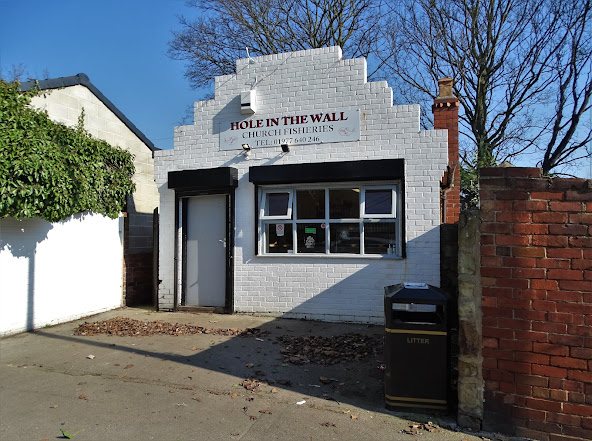
Second picture - Fish and chip shop in South Kirkby
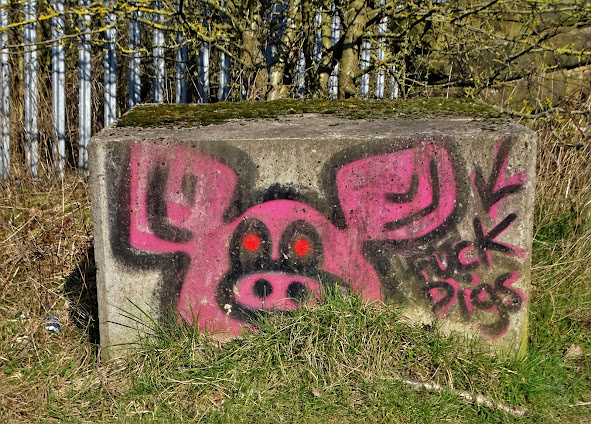
Third picture - Image on a concrete block by the railway at Mutton Flats
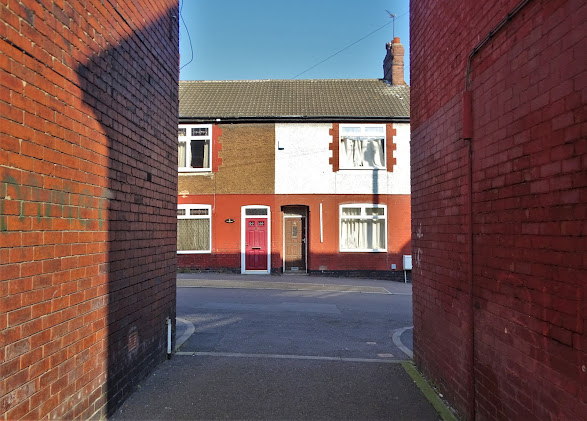
Fourth picture -  Terraced streets at Moorthorpe
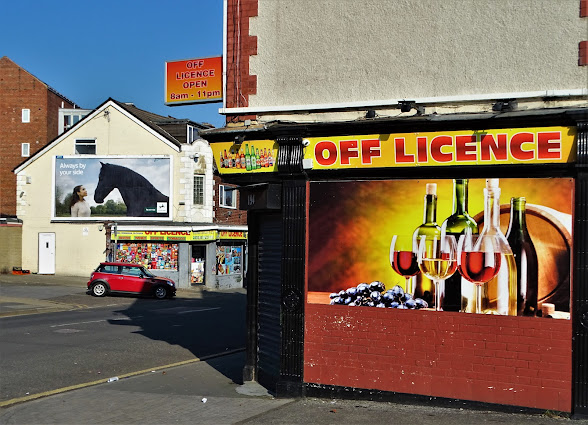
Fifth picture - Two off licences at Moorthorpe (American - liquor stores)
Sixth picture - Statue of a coalminer at South Kirkby

7 March 2022

Poem

Ukraine March 7th 2022
     
Once upon our TV screens
War unfolds as if in scenes
From some technicolour dream
Though bombs aren’t always as they seem...
“There are no threats to the civilian population”.

“Just one toy Oleksander!” we said.
He took his old teddy from under his bed.
We piled in the car and headed west,
As options went, it appeared the best...
“There are no threats to the civilian population”.

Fires, no water and bodies in the street,
Old Baba Shevchuk under a sheet.
War planes cleave our darkening skies
Targeting the tyrant’s lies...
“There are no threats to the civilian population”.

Top picture  ©Diego Herrera Carcedo/AP

6 March 2022

Blues


Refugee Blues

Say this city has ten million souls,
Some are living in mansions, some are living in holes:
Yet there’s no place for us, my dear, yet there’s no place for us.

Once we had a country and we thought it fair,
Look in the atlas and you’ll find it there:
We cannot go there now, my dear, we cannot go there now.

In the village churchyard there grows an old yew,
Every spring it blossoms anew;
Old passports can’t do that, my dear, old passports can’t do that.

The consul banged the table and said:
‘If you’ve got no passport, you’re officially dead’;
But we are still alive, my dear, but we are still alive.

Went to a committee; they offered me a chair;
Asked me politely to return next year:
But where shall we go today, my dear, but where shall we go today?

Came to a public meeting; the speaker got up and said:
‘If we let them in, they will steal our daily bread’;
He was talking of you and me, my dear, he was talking of you and me.

Thought I heard the thunder rumbling in the sky;
It was Hitler over Europe, saying: ‘They must die’;
We were in his mind, my dear, we were in his mind.

Saw a poodle in a jacket fastened with a pin,
Saw a door opened and a cat let in:
But they weren’t German Jews, my dear, but they weren’t German Jews.

Went down the harbour and stood upon the quay,
Saw the fish swimming as if they were free:
Only ten feet away, my dear, only ten feet away.

Walked through a wood, saw the birds in the trees;
They had no politicians and sang at their ease:
They weren’t the human race, my dear, they weren’t the human race.

Dreamed I saw a building with a thousand floors,
A thousand windows and a thousand doors;
Not one of them was ours, my dear, not one of them was ours.

Stood on a great plain in the falling snow;
Ten thousand soldiers marched to and fro:
Looking for you and me, my dear, looking for you and me.

by Wystan Hugh Auden (1939)

5 March 2022

Elmer

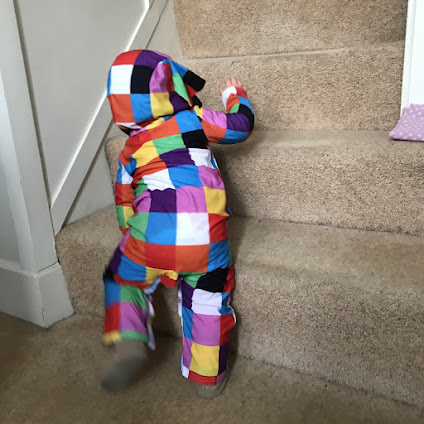
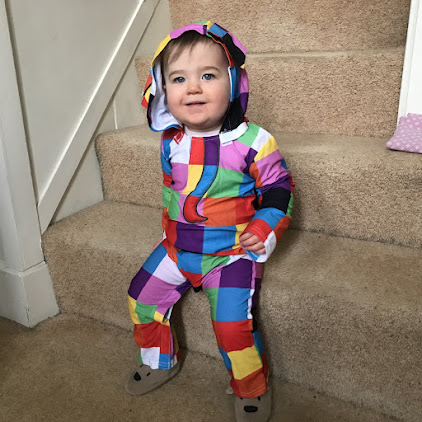
Who is that at the bottom of our staircase? It can't be can it? Yes it is! It's Elmer the Elephant. 

In truth, Elmer the Elephant was the invention of British illustrator David McKee. Elmer is a patchwork elephant and the star of several children's books. He has also spawned a range of associated items - pencil cases, jigsaw puzzles, short animated films, cuddly toys, colouring pens etc..
On Thursday it was "World Book Day" at Phoebe's nursery. Though Phoebe had slept over at our house, her mama - who was down in London for two days - requested that we dress the little princess in the Elmer costume she had ordered.

And here she is, almost fourteen months old now, and may I say, as delightful as ever, even if she does look slightly ridiculous in her Elmer costume:-

Most Visits