18 January 2016

Revenant

There's a scene in the second half of "The Revenant" when, in order to survive the night, frontiersman Hugh Glass removes the innards from his just dead horse and climbs inside the rib cage to sleep. Glass is played superbly by Leonardo DiCaprio in a film that pulses with physicality.

Davy Crockett may have been "the king of the wild frontier" but I am sure that his particular frontier was sugar-coated. In contrast, the wild frontier created by director Alejandro G. Iñárritu is truly wild, brutal and yet sometimes breathlessly beautiful. In this landscape, white men are seeking their fortunes as fur trappers while native American tribes battle to hang on to their vanishing world. It is cold and the pine forests are tall. Icy rivers run through the mountains and wild animals stalk this challenging  wilderness.

DiCaprio as Glass seeks revenge for the needless murder of his son. His quarry is the amoral, opportunist - Fitzgerald played by Tom Hardy. Like Christian in John Bunyan's "A Pilgrim's Progress" Glass has many trials to face as he pursues his vengeful destiny - not least of which is a fearsome attack by a huge grizzly bear.

Throughout "The Revenant" you hear DiCaprio's heavy breathing, his grunting, his pain. It is a remarkable performance, enhanced by Iñárritu's vision and the team he gathered around him to make this marvel of modern cinematography. If Leonardo does not receive the best actor award at this year's Oscars, then I will eat my hat which is by the way a woollen Hull City beanie.
16 January 2016

Eakring

Eakring Church
I had planned to visit the cinema yesterday to watch "The Revenant" but with bright blue skies and wintry sunshine confidently predicted, I decided to forego that pleasure. Instead, I sought somewhere I had never walked before. My alter ego whispered, "Go east young man" and soon I was driving down to Chesterfield, then east on the A617 towards Mansfield. Through Mansfield then out on the Newark road. After three or four miles I turned left down Eakring Lane.
Old shed by Eakring Lane
St Bartholomew's in Kneesall
I parked by  the village church at Eakring and then set off on a very pleasant circular walk  that took in three other villages - Kneesall, Kersall and Maplebeck. In between was gently undulating farmland and some stretches of the route I had planned took me across winter corn and beet fields. Then the walking became a little arduous as my purchase upon the ground was troubled by slightly icy muddiness underfoot.
The disused telephone kiosk in Kersall
Signposts on Hare Hill 
To walk in unfamiliar territory is delightful. New vistas. A different history. In that part of Nottinghamshire, the field boundaries are marked by hedgerows  - not ancient drystone walls and the favoured building material of bygone days was brick - not stone. There are few quarries in the region but our ancestors still managed to build their churches from stone which must have been imported with massive effort from elsewhere.
The church in Maplebeck
One of only five churches in England dedicated to St Radegund
Being mid-January, the bright winter sun was on its way to America by 3.45pm so a military march was required to get back to Eakring before nightfall. I had seen an undiscovered fragment of England - chosen randomly but I was not disappointed. It would have been easy to linger thereabouts for  a few days - drinking and eating in the pubs, learning more about the area's history and perhaps visiting the oil well museum in the splendidly named Pudding Poke Wood!
New footbridge east of Eakring

13 January 2016

Rambling


Roger de Busli was granted the lands around Tickhill and Blyth soon after The Norman Conquest which followed The Battle of Hastings (1066). Tickhill or Dadesley as it was then known had been an important Saxon stronghold and it was here that Roger de Busli, arranged for the building of his fortress in the typical Norman style. Vast quantities of earth were moved to develop the mound on which his castle was built.

It must have been a huge undertaking but the castle would have made an  impressive statement to his new and privately suspicious subjects. For the following five hundred years the castle played an important role in the governance of this part of England but in 1647, after The English Civil War, much of it was demolished - including the Norman keep. Only its substantial foundations remain along with  the gatehouse and part of the moat. The castle grounds are rarely open to the general public and they are overseen by The Duchy of Lancaster as they have been since 1362.

That is where I parked yesterday before setting off on an ancient path that once linked Tickhill with Blyth. But I wasn't bound for Blyth. After half a mile, I turned eastwards under the A1 motorway and entered the village of Harworth.

For most of its history, Harworth had been a small and quite insignificant agricultural village until deep coal mining commenced there just before the outbreak of World War One. Soon the population exploded. Rows of miners' cottages were built along with shops, schools and other local facilities. It became a hardworking industrial place where money was persistently tight even though the mine was always very profitable.

In the late eighties a huge pithead tower was  built to house the winding gear and up-to-date ventilation machinery. Though most of the other pithead buildings have now gone, the concrete tower remains, watching over the local landscape just like the keep of Tickhill Castle in bygone years. Officially it is said that Harworth Colliery has simply been "mothballed" but it is now ten years since work ceased there. Millions of tons of coal still lie underground but I very much doubt they will ever see the light of day. The infrastructure has been broken and on the colliery land new housing estates are rising.

I left Harworth via the Tickhill Road and once back in Tickhill  diverted to the magnificent St Mary's Church - though by then the light was fading as another winter night approached. Back at the car, I vowed to check out Tickhill Castle open days and to plan a trip back - perhaps in the summertime when leaves have dressed the trees once more and the humming of insects under a bright blue sky can again be heard. Such days seem quite far off right now.

Pictures of Harworth:-

Units

"Men and women should drink no more than 14 units of alcohol a week - the equivalent of six pints of average strength beer or seven glasses of wine - in order to keep their health risks low, new government guidelines have recommended."

That's the latest official health advice in Britain. The grim-faced "experts" warn us about cancers of the mouth and intestines, obesity, clinical depression, breast cancer in women, liver and kidney failure, heart disease. And so it goes on.

However, these killjoy prophets of doom fail to acknowledge the benefits that moderate consumption of alcohol can bring. The laughter, the lubrication of conversation, the relaxation, the social nourishment. And they also fail to explain away the fact that the consumption of alcohol has been a part of daily living in Britain since the Romans first came to these islands. 

Most British adults enjoy a tipple. I am not talking about binge drinking or excessive consumption but sensible enjoyment of beers, cider, wine and spirits - whatever floats your boat. Alcohol has been part of my life for forty five years and I haven't been buried yet nor have I suffered any health complaints connected with alcohol so how am I meant to take this fourteen unit advice seriously?

I guess that the sour-faced experts would prefer it if we all went to bed at 9pm, ate salads ever day, visited the gym three times a week and went to church on Sundays. If I limited myself to fourteen units a week I might as well just forget drinking at all. Besides what is life for? The champions of The Unit Religion never seem to address that fundamental matter.

Even as I write this post, I am drinking a lovely bottle of "Henney's" Classic Cider from Herefordshire and it's a nice drink too  - probably two and a half units of my weekly allowance. But tomorrow night I will be going to the pub quiz at "The Hammer and Pincers" where I expect I'll sup four pints of India Pale Ale by "Greene King". How many units is that? Probably nine.

I hate that word "units" anyway. It sounds scientific and measurable. I prefer a different kind of language for alcohol. Visiting the Henney's website, I find these kind of words in place of "units" and miserable research vocabulary - "Sweet appley aroma, palate has a delicious bittersweet apple character with some  spicy bite and a bit of tannuc grip. Very fruity and quite pure with a nice savoury twist."

So in conclusion, I won't be buying a unit notebook any time soon in order to keep a detailed tally of my alcohol consumption and I certainly won't be toasting the proponents of the fourteen unit idea. The only concession I shall make is to try a bit harder to ensure that there are  two or even  three days a week when I don't drink any alcohol at all.

12 January 2016

Encore

Stanage Edge on Sunday

To the left of the top bar in each Blogger blog there's a little blank box with a "search" magnifying icon next to it. It took me a few years to even notice this clever search facility. It allows us to make searches of particular blogs - seeking the use of individual words or phrases. Then Blogger will quickly reveal to us the various posts in which this word or phrase has appeared  in  past postings.
For example, search for "male hunks" in "Kitchen Connection" and you will discover dozens of related posts. Or search "Rhymes With Plague" for "heavy metal music" or "Barack Obama fan club"and many old posts will be regurgitated.

I was with Shirley on Sunday afternoon - driving over the moors towards The Hope Valley and, upon noticing dramatic January light illuminating the millstone escarpment of Stanage Edge, I just had to pull over to snap the picture you see at the top of this post.

Back home, before making this post, I used the blog search facility - inserting the word "Stanage"and discovered that I have previously made twelve  blogposts in which Stanage Edge figures strongly. There are even two posts that are titled "Stanage".

If you have never used the built-in search facility to comb through your own blog, or indeed other people's blogs, you might like to give it a try. It can be useful and indeed illuminating - like the light on Stanage Edge.

10 January 2016

Images

Hello again. Your jolly blog host saw  some ugly weather in the past week. Grey skies, teaming rain and puddles. The swishing of windscreen wipers. One's coat hood pulled up in eskimo fashion. One's little face peeping out with mouth turned down. Early January - rarely the best time of year in the northern hemisphere.

Yet there were some clement hours when the rain went home for lunch and Mr Sun peeped through the clouds. On Friday afternoon, your jolly blog host wandered around a part of Sheffield that overlooks the Don Valley. In the city's industrial past, this valley was our smoky workshop. The thumping of steam hammers. The blinding satanic glow  of furnaces. Workers lived in terraced streets that marched up the valley side. But that was then and this is now.
"The Grapes Inn", Burngreave
Sutherland Road and the city's modern "Energy Recovery"  incinerator
Maxwell Way, Burngreave
Rear of an industrial building on Forncett Street
On Saturday, I drove over to Hull to watch The Tigers with old friend Tony. It was the third round of the F.A.Cup and we deservedly beat Brighton thanks to a Robert Snodgrass penalty that almost burst the net. On the way over, I followed a voluntary diversion into the town of Goole (Population 17,500).

It is where my brother Robin was born and it is still a significant inland port. Happily, neither of the parking ticket machines in the car park were working so I was able to write a joyful message on an envelope "Machine Not Working - 11.30am" and this I duly left on my dashboard before strolling about the town like a secret agent on a spying mission.

An hour and twenty minutes was not long enough. Your jolly blog host must go back to see some more including the Yorkshire Waterways Museum, Old Goole and the docks. Without clever drainage methods and without the docks, Goole would not even exist. It is a flat, watery and characterful settlement at the end of the River Ouse, close to the meeting places of other rivers that feed into The Humber.

Admittedly, all the words typed above were just an excuse for posting more pictures. Image is everything.
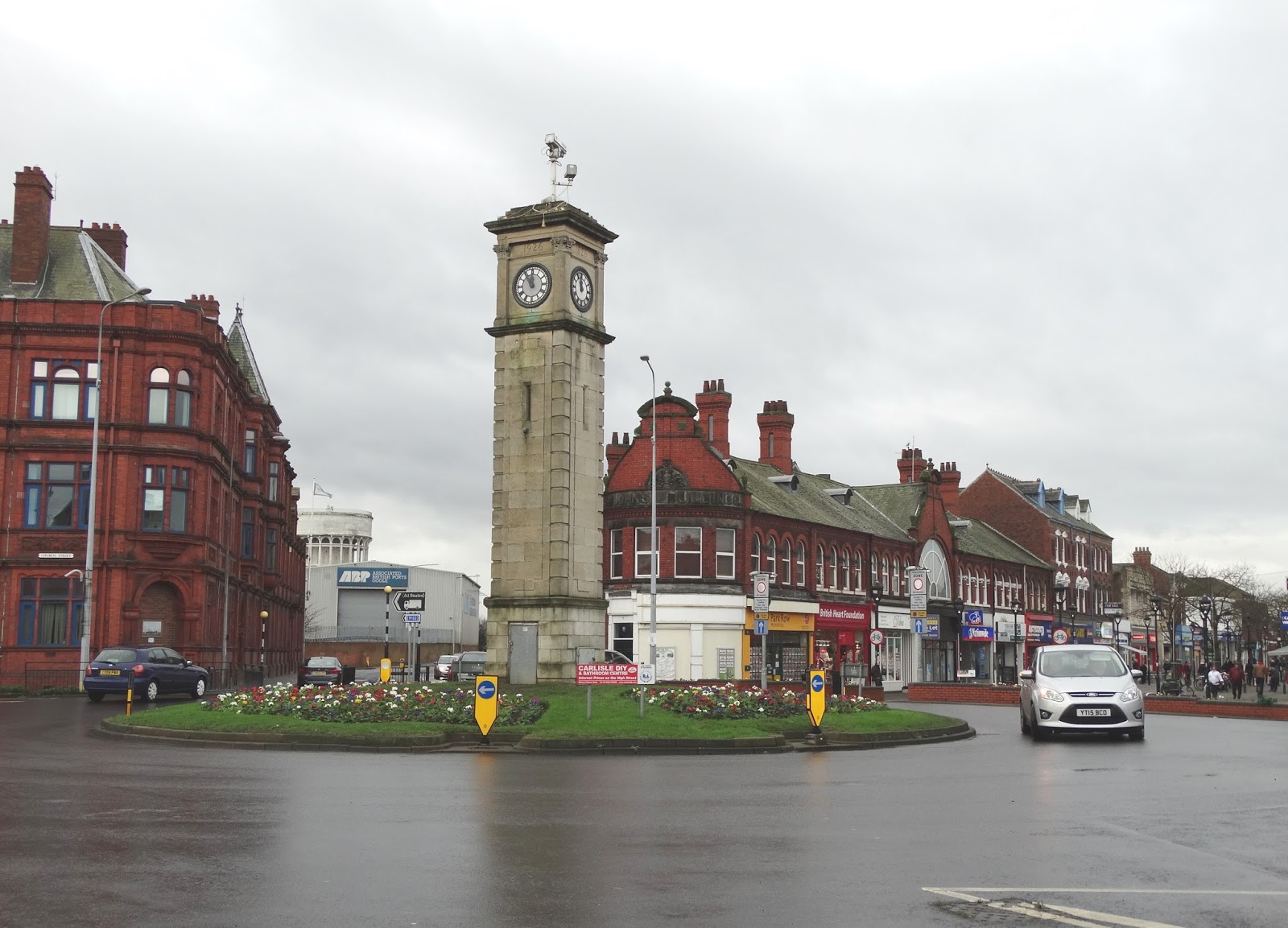
The cloctower erected in 1926 to mark the centenary of the town's docks
The Seaman's Memorial in Goole
Town on the left. River Ouse on the right.
The banking is vital to prevent flooding.
"The Macintosh Arms" on Aire Street
Named after docks engineer Hugh Macintosh

Most Visits