8 January 2014

Running

When you can look back over half a century, you notice many changes. Of course there are the obvious things. My family's first television boasted two rather primitive channels - both in fuzzy black and white. I can remember when it arrived though I am still grateful that the first six or seven years of my life were spent in a largely peaceful, television-free home. Today television is sharp, colourful and clear. Programmes are slick and professional - even though you may not like many of them. And there's so much choice.

Then there's the often mentioned computer technology and air travel. Both have changed the way we see the world and how we communicate.

And I can recall the very first supermarket that opened in East Yorkshire - the "Savemore Stores" near King Billy's golden statue in Hull's old town. Our family began to go there every week. My mother always loved a bargain - probably because she herself was raised in poverty close to the coal mine where her grandfather worked. That first supermarket was a rough old place with narrow aisles you had to squeeze down and boxes piled high. Today's supermarket palaces appear to have been designed by space scientists, interior designers and logistics gurus, working in tandem to squeeze as much profit out of shoppers as possible.

Nowadays running and jogging are very common. There's a whole industry devoted to this rather bizarre activity. You see runners puffing along in parks and suburban streets or rural lanes. Frequently, while I am plodding in the countryside admiring the view, runners in fluorescent vests will whizz by me. But when I was a boy nobody went running - apart from dedicated athletes at running tracks or schoolchildren on obligatory cross country runs. The idea of running as a leisure or fitness pursuit for ordinary people was out of the question. So canal tow paths, public footpaths, village or suburban streets were all runner and jogger-free zones.

Today we have sports shops - sometimes of warehouse proportions - stocked with a whole array of sports shoes - what we English call "trainers". But as I recall, in the early sixties there simply weren't any "trainers". The few people who did take up running would wear special "spikes" and for PE lessons children would wear canvas plimsolls or "sand shoes". It was only towards the end of the sixties that shoes resembling modern trainers began to appear. I can still recall my first, second-hand pair. They were light blue "Adidas" shoes with white stripes down the side but I didn't wear them for running, they were for teenage coolness. "What are you wearing them again for?" my exasperated mother would demand to know.

So there we have it. A sixty year old old phart observing the passage of time and some of the changes he has seen. And isn't it interesting how birds of a feather flock together - so that blogs like this one or "Helsie's Happenings" or "Going Gently" or "Adrian's Images" or "Rhymes With Plague" tend to attract senior visitors? I am not sure why this should be as none of us put up barriers to warn off teenagers or twenty-somethings. Perhaps we have bored them away. But what I really wanted to learn about was some of the changes you have noticed - perhaps less obvious ones like the running phenomenon I have highlighted above

7 January 2014

Sheep

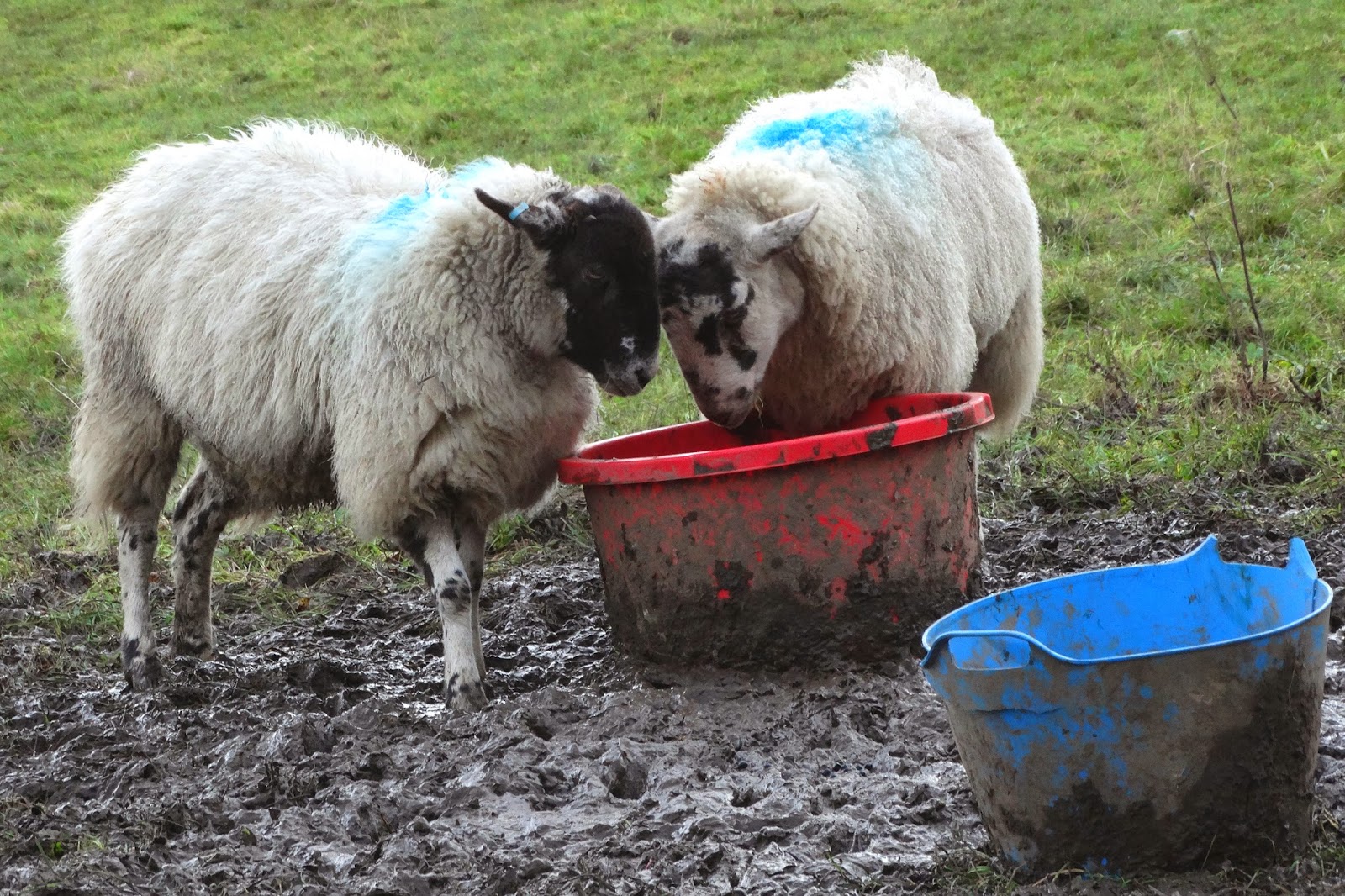
A rather grey January afternoon. Whilst walking in the Mayfield Valley - just five minutes by car from our house - I stopped to take wintry photographs of some sheep by Old May House. I was partly attracted by the red and blue buckets - containing food supplements. Being an arty-farty kind of fellow, I thought those colours would add extra visual interest.
Sheep are not native to the British Isles. It is believed that they were first introduced about four thousand years ago by our neolithic ancestors. As centuries passed, ovine husbandry advanced and by the middle ages, British sheep were a source of enormous wealth. The woollen industry was largely responsible for the growth and national importance of several East Anglian towns - including Thetford, Kings Lynn, Norwich and Bury St Edmonds. Back then these places were far more significant than Manchester, Sheffield, Birmingham or Liverpool - towns that only really came to prominence in the late eighteenth century.

Below there's an exceedingly woolly sheep that I spotted above Hathersage a few days ago. She  must have managed to dodge the shearers in the summer.
She belonged to this small flock, backlit by sunshine streaming into the Hope Valley through  late December mistiness:-
As previously remarked, sheep are not native to these islands but neither are cows or goats - nor rabbits or chickens. And it's worth remembering that wheat, potatoes and all salad plants were also introduced at different times. It makes you wonder exactly what our distant ancestors ate. Fish, oats and other grasses, certain roots, berries, hunted animals such as wild boar and deer, birds, birds' eggs, native plants like nettles and comfrey. I'm not even sure that the latter  are in fact native plants. It must have been such a  challenge to put food on the table each day - especially in wintertime.

6 January 2014

Goodwill

Now that's a hell of a picture! The location is Porthcawl near Bridgend in southern Wales. The photograph was taken yesterday afternoon and has been used on the BBC News website to illustrate the ongoing stormy weather in the south west of the country. Meanwhile here in Sheffield, it is still calm. I visited the supermarket earlier wearing  a T-shirt (err...trousers and shoes too) and the sun is out.

An hour ago I went up the garden to dismantle our Christmas garden display. Always a sad thing to do. Controlled by a timer, our dark Yuletime nights were prettily lit by a glowing Father Christmas with a string of flashing red lights above him. All observed by a be-tinselled Beau and Peep - our obedient pet sheep. Now it's clear that Christmas 2013 is really over and we are well into 2014. I must make some travel plans - The Isle of Man, Montenegro, Seattle and Vancouver perhaps...

Michael Schumacher is still in a coma after his awful skiing accident and now Mrs A. Merkel - the German Chancellor has fractured her pelvis while skiing. It has always seemed a silly activity to me. I wonder if it is possible to sponsor an Alpine skiing trip for our own chancellor , the odious Gideon "George" Osborne with a coachload of other irksome "celebrities" - including TV and radio "personality" Chris Evans, the entire England cricket team, Jordan (aka Katie Price), Leonardo di Caprio, Stephen Fry and Bashar al-Assad. After all, the season of goodwill is now officially over.
The west garden of Pudding Towers on Christmas Day

5 January 2014

Men

Putin - so manly at only 5 feet 6 inches.
Women must often thank their lucky stars that they are not men. Being a man is hard. There are many difficult things to learn and challenging skills to master.

When men sneeze, they mustn't emit pathetic, whimpering sneezes but full-blown, powerful blasts that make small children and sleeping pets jump. To achieve this impressive level of sneezing takes months of secret practice and I am eternally grateful to my late father Philip for the many hours he spent with me down by our local canal teaching me the art of manly sneezing.

It's exactly the same with the passing of noxious wind. Real men must fart like trumpeters - not sneaking them out with feminine silent apology. A manly fart should reverberate, causing the performer to smile with a sense of masculine achievement and pride. It should measure no less than 160 decibels and if possible form a small chain of loud emissions - not a solitary blast.

Burping requires a lifetime of exercise in order to maximise length, volume and the disgusted glances of female witnesses. Of course, certain foodstuffs and drinks will aid the production of impressive burps. Personally, I find that "Pepsi Max" is excellent burping fuel and from one single can I can easily muster fourteen or fifteen manly burps.

Men have to learn to master a range of manly devices from the screwdriver to the electric lawn mower and from the power drill to the television remote control. Even so, there are devices that real men must never come to terms with and these include the vacuum cleaner, the steam iron with ironing board, food mixers, automatic washing machines and central heating controls. Real men do not feel the cold and even when their home is freezing like The North Pole they must walk around in string vests and underpants, scratching their private parts while announcing "I'm not cold".

When proper men go shopping, they do not browse or loiter. They have no understanding of the term "leisure shopping". Visiting the shops is like a Viking raid. You know exactly what you want. You go into the shop, purchase it and then get out  as quickly as possible. This is why the average family man only spends a maximum of ten minutes on Christmas present shopping each year.

To be a fully qualified man you must be able to fight. Okay you are not going to be fighting every week or even every year but you must always be ready. You never know when you are going to need to get another bloke in a headlock or beat him to the floor. It's probably something inscribed deep in our DNA that goes back to our hunting and gathering ancestors

Modern men - at least in the rich western world - drive cars. When in charge of a car a man must adopt a state of mind in which he sees himself as the world's best driver. As he looks out on other road users he will see thousands of mindless wallies whose driving skills are so appalling that they will require certain hand gestures, mouthed swear words and angry blasts from the horn.

With regard to food, a man must never leave an empty plate. He must eat the entire meal - no matter how high the plate has been piled. This will include fat, gristle, bones and any accidentally included foreign bodies such as caterpillars or hairs. And naturally when the meal is over he must signal his satisfaction with a manly burp. It is the same down at the pub where a man should never partake of soft drinks or less than five pints of beer on each visit.

Yes. Being a man isn't easy. I have tried my best to pass on all that I know to my own son and am happy to report that he is a chip off the old block - demonstrating his manliness each day in most of the ways described above. As Rudyard Kipling wrote:-

If you can sneeze with power and keep your virtue,
Or fart like Kings - nor lose the common touch,
If neither foes nor loving friends can outburp you,
If all men fight with you, but none too much;
If you can clear your plate in just a  minute
With sixty seconds' worth of distance run,
Yours is the Earth and everything that's in it,
And - which is more - you'll be a Man, my son!
William Tell and son

4 January 2014

Storm

This dramatic picture from Saltcoats, Scotland has appeared in several British newspapers this morning. It shows a train travelling along the Ayrshire coast by the Firth of Clyde. In recent days, our national media has been filled with tales of meteorological doom and gloom as our country has apparently been battered by  a succession of winter storms surging in from the North Atlantic. In contrast, here in tropical Sheffield I am happy to report that the weather has been unexceptional and at times positively balmy.

Not for the first time, it has been interesting to observe the BBC generalising from the particular. Down in the south east - home to BBC people, politicians, Arabian sheikhs, bankers and the like there has been flooding and stormy weather. Rather arrogantly, news teams have concluded that this bad weather has been a nationwide phenomenon. It hasn't. The same thing happened during the so-called "Great Storm" of 1987.

It's the same when a street murder occurs in London. We hear all about it but if an identical murder happened Up North, it would be either overlooked or given minimal airtime. The London bias is often blatant but sometimes subtly endemic.

Meanwhile, in The Pudding Mansion, I am alone with a mug of tea. Shirley is doing a rare Saturday morning shift at the health centre. Frances is back at her flat in Leeds and Ian travelled back to London yesterday afternoon. It was so lovely to have them both at home this Christmastime. We feasted and relaxed and they met up with old friends. We are lucky to be blessed with two such kind, morally decent, fun-loving and hard-working "kids" - though they are not really "kids" any more. Ian will be thirty this year and Frances will be twenty six. How time flies.

3 January 2014

Ladybower

Fifteen minutes due east of Sheffield, you arrive at the Upper Derwent Valley where three large reservoirs were created in the nineteen thirties. They are Howden, Upper Derwent and Ladybower and it was largely by the last of these that I was walking yesterday afternoon. A sad thing about Ladybower is that when the valley was dammed, two small but significant villages had to be drowned. They were Ashopton and Derwent. Less than half of Derwent remains and these gateposts that are now in a thicket on the edge of the reservoir once led to the old vicarage:-
Here I am looking over Ladybower from the track that leads up onto the moors:-
Here's the remains of Bamford House - an old farmstead on the valleyside above Upper Derwent:-
Here you can see two visitors and their dog standing in front of one of the dam walls - near the Fairholmes Visitor Centre. As you will observe, water is cascading over the dam after heavy rain the day before:-
Click picture

Back at my parked car, I notice Ashes Farm overlooking what remains of Derwent Village. A working shepherdess called Kath Birkinshaw lives here. She is a remarkable, hard-working woman who came down from the hills last year to speak about her life at Shirley's Women's Institute. Her father and grandfather before her were sheep farmers. Talks to local groups help to supplement her meagre farming income. There's not much money in sheep these days.

2 January 2014

Shindig

Chatsworth House is arguably England's finest stately home. It was there last evening amidst much pomp and ceremony that the Laughing Horse blogging awards were presented to the various winners. Above you can see fireworks bursting in the Derbyshire night and the grand Regency house itself distinctively  illuminated in blue. Use of Chatsworth had been made possible only because the writer of these words has become a personal friend of the Duke of Devonshire over the years - since meeting in "The Castle" pub in Bakewell back in 2001.

The house boasts over 175 rooms and a third of these are luxurious bedrooms so there was plenty of accommodation for Laughing Horse winners though Mr R. Brague had to be satisfied with an austere room in the servants' quarters. It used to be the private suite of a former butler and notable womaniser called Percy.

The main event took place in the Grand Ballroom which in its heyday looked like this - very suave and sophisticated:-
But on the Awards Night, it looked more like this as bloggers from around the world attacked the free bar and drank as if the apocalypse was to happen the next morning:-
Katherine from NZ, Carol from Cairns and Helen from Brisbane at the ballroom bash
After The Arctic Monkeys (from Sheffield) had performed on the ballroom stage, the room was skilfully hushed by your faithful compere - "SHUT THE F*** UP!"  "Pray be quiet!" I bellowed. A bucket of iced water was thrown over Ms Kate De Chevalle, the bohemian Kiwi artist  as she had continued shouting at the top of her voice - "One Edouard Manet! There's only one Edouard Manet!" like a rabid football supporter.

The awards were presented by The Duke of Devonshire who welcomed the international blogging community to his home and said he'd spotted some gorgeous "fillies" in the assembled ranks who he would happily invite to join him on an invigorating morning ride. "Dirty sod!" whispered Adrian from "Adrian's Images".

The first award was presented to itinerant blogger, Mr GB from both Napier, New Zealand and Eagleton, Isle of Lewis, Scotland. Dressed in an evening suit and with his beard neatly trimmed, it was unfortunate that Mr GB hadn't realised that his flyhole was unzipped and this fact caused much suppressed mirth as he read out his lengthy acceptance speech. It was even more unfortunate that the tail of his dress shirt was peering through the hole like a miniature white sail.

Penguin-like waiters flitted about the seated guests, filling their crystal champagne glasses while the awards ceremony proceeded.

Overall Welsh winner, Earl John Gray of "Going Gently" of course delivered his acceptance speech entirely in Welsh, putting his success down to the inspirational power of scotch eggs and the love and support of both his animals and his long-suffering partner and live-in therapist Dr Chris of the University of Bangor's Bestiality Studies Department. Throughout it all, Jenny the "Demob Happy Teacher" smirked at the Earl's woeful pronunciation.

Top Catalonian blogger Brian Cutts appeared on the stage in traditional Catalan dress, raving that his "people" needed the support of the rest of the world if they were to achieve independence for Catalonia and remove the repressive yoke of Spanish imperialism:-
Top Feline Care Blogger, Jan Blawat slid onto the stage like a cat, wearing a tight-fitting cat suit made entirely from feral cat fur. "Hi y'all!" she grinned coquettishly as The Duke of Devonshire's blood pressure rose like an old steam locomotive preparing to leave King's Cross.

And then The King himself was called - The Blogger of the Year who had arrived from Johannesburg that very morning. Dressed in a khaki safari suit and wearing a brand new bush hat made by "Tilley" of Canada, he looked every part the adventurer with medals dangling from his breast and an electronic cigarette in his muscular right hand. 

"Oooo! He's gorgeous!" swooned Carol from Cairns.

Cap'n T. Gowans pulled out his long speech. It had been written on Izal toilet paper and rolled back into a familiar cylindrical form. It was a speech that should have been witnessed by "The Guinness Book of Records" people such was its length. It covered happy childhood  days in and around Cannock Chase, the important influence of his beloved father, the trials and triumphs of soldiering, snake bites, whisky, African maidens, the love of his two sons, vehicle maintenance, man management, cooking in a medieval helmet, the importance of accurate grammar and spelling, Cliff Richard, his brothers, map reading, airport security....zzzzzzzz!

"God, he goes on a bit doesn't he?" moaned Adrian.

And Mr R. Brague agreed as they slugged back their French champagne.

Finally, Cap'n Gowans was suitably applauded and the evening consequently descended into an unwholesome vision of debauchery and excess that was reminiscent of Gomorrah. After being plied with strong drink, Jan Blawat - the Catwoman - was ushered away to The Duke of Devonshire's private quarters while Katherine de Chevalle's tongue explored Brian Cutts's Catalonian tonsils in the exotic palm house and Earl John Gray chased one of the liveried footmen up to the hay loft in the stable block. And throughout it all, the author of this post sat in a wing-backed armchair like Methuselah with legs crossed simply observing the goings-on. What a night!

Most Visits