15 June 2020

Saola

What is there to do on a Sunday night when there is nothing of interest on the television and you are in the fourth month of a pandemic lockdown? Of course, you google around until you find a list of the word's most critically endangered animals.

Most of the beautiful and unique creatures on that list are pretty well-known -  The Sumatran rhino, the orangutan, the hawksbill turtle, The Eastern Lowland gorilla etcetera. But there was one creature on that list that I admit I had never heard of before - the saola.

This member of the antelope and bovine families was not recorded by zoologists until May 1992. It was discovered in the forests of north and central Vietnam. Think of that... all the time The Vietnam War was being played out, shy saolas were grazing nervously in the shadows - even as helicopters whirred overhead and agent orange was raining down in the name of freedom.
There are not many decent photographs of saolas - probably because they are so rare. In December of last year it was estimated that there are only between seventy and 750 left in the wild. Even as I write this blogpost they may all be gone but I hope not. I hope that there are sections of virgin forest where they still feed and reproduce in peace.

In neighbouring Laos the creature is called the saht-supahp which means "the polite animal" - probably because of its quiet behaviour.

Saolas are herbivores. They seem to give birth to single calves. They have twin horns that sprout from the skull very close together and undoubtedly that is why they are sometimes known as "The Asian unicorn".

Like several other critically endangered animals, the saola's chief threats come from humankind. Forest habitats have been reduced or invaded by loggers and local hunters have killed them for their meat. It's the same old story. 

Bless the saola.

14 June 2020

Answered

God came through for me yesterday. Soon after pleading with him to lift the big grey cloud, it was gone. Praise The Lord! Praise him! He poured his blessings and his munificence upon me. What is more, everybody else in Sheffield's western suburbs reaped the benefits too.

Lunch was bacon sandwiches with mugs of tea. Then I saddled up Clint and we galloped off to Common Lane on the edge of the city. I tethered him there in spite of his whinnying and donned my walking boots.

I wasn't far from home but I found a couple of public footpaths that I have never walked along before and that's after living in this house for thirty one years. The sun shone and the blue firmament appeared through large holes in nonthreatening clouds that sailed by like stately galleons of yore.
Wild foxgloves were everywhere, sheltering and supported by drystone walls. Other Sheffielders were out and about, walking like me or jogging or cycling - none of us far from home. Some of them said "hello" as our paths crossed and some looked away. I always smile and say "hello" in a friendly manner whenever I pass strangers. It's the least I can do.

Soon after passing by Whirlow Hall Farm I encountered a fellow I have know for twenty five years or more. We always have a good old chinwag whenever we meet.

He's called Paul and it turns out that back in April he was in hospital for five days with COVID. His brother and sister-in-law also had it. Paul reckons that the infection occurred when he went to The Northern General Hospital upon request to pick up his aged mother. They had to transfer her to a residential home though she herself had not contracted the virus.
Paul didn't have to be attached to a ventilator but it was touch and go as he gulped breaths of pure oxygen through a mask. I made sure that I maintained a two metre distance when talking with him but even so it was nice to catch up.

By Thryft House Lane I spotted four separate rainbow stones that had clearly been painted by a child. I took photos of each one of them and joined them up for the image at the top of this page.

Thank you Almighty Father for giving me a nice afternoon that felt more like summer again. It's nice to have one's prayers answered so efficiently. More kind acts like this Lord and you will surely go to Heaven.
Sheffield's green western suburbs with Whiteley Wood Hall ahead

13 June 2020

Plea

What happened to the English summer? Who stole it?

I woke this morning to a Novembery kind of mist. You could hardly see the houses beyond our back garden. A lone crow was pecking at the stale bread I scattered on the lawn last evening.

Yesterday was bloody miserable with dribbly grey rain most of the day but lashing down  like bullets around two in the afternoon. No long country walks for me - I was trapped indoors, procrastinating like a procrastinating donkey. I watched far too much television including "Tipping Point", "The Chase" and "Celebrity Gogglebox" - interspersed with visits to my "go to" news channel - The BBC World News service. 

Tuesday June 2nd was the last lovely day we had. I was in  shorts and T-shirt up at the woodland car park at Ringinglow - just beyond the alpaca farm. In fact the other lads and I have started calling our outdoor pub "The Alpaca Arms" just for fun - but we didn't go there this past Tuesday afternoon - it was far too autumnal and wet with a thick grey blanket of cloud overhead.

Of course our gardens are loving this weather after our exceptionally dry and sunny springtime. Rain water was needed so desperately but now Almighty God we have had enough my friend. Please get your angels to unbutton the sky and let summer sunlight stream down once more from sapphire blue skies.

This is meant to be "flaming June" but since the second day of the month it has been flaming awful. Don't you think we have got enough to cope with Oh Great Jehovah? First you make BoJo The Clown our prime minister, next you dump COVID  upon us and stand back while George Floyd is cruelly murdered  by a racist policeman, then you take our blue skies away! It's not fair Lord. Please rethink your strategy sir.

Give us back our summer!
Location of "The Alpaca Arms" - courtesy of Google Streetview

12 June 2020

Silliness

What's the silliest thing you have ever done? I guess you will only reveal what you want to reveal. Maybe there are even sillier things that you wish to keep secret! Silly things can be accidental or deliberate.

Years ago, after a ferry journey from Ireland and a long drive across southern Wales, we ended up at my brother Robin's house in Winchcombe, Gloucestershire. I was pretty tired and it was quite late so we decided to have takeaway fish and chips for our evening meal.

There we were round the table. Our children were still very young and for a treat they were drinking squat little bottles of cola. Those bottles were very similar in size and shape to the vinegar bottle. You guessed it already. I reached out for the vinegar and ended up pouring cola all over my lovely golden cod and chips.

Everybody laughed and the moment was so deeply etched in my little daughter's mind that for years afterwards she would remind me: "You put coke on your chips!" What a silly billy I had been!

In late 1978 there was a Christmas disco party in the lower school of Dinnington Comprehensive in the heart of South Yorkshire's coalfield. It was agreed that attending staff members would don fancy dress just for fun. This was in the days before paedophilia became newsworthy.

I decided to go as a dirty old man. For some reason, I already owned a rubber mask complete with hair, a bulbous nose, warts, bushy eyebrows and wrinkles. At a charity shop I bought an old brown Macintosh coat that was grubby and a size too big for me. I put a flatcap on that my mother had previously created on her sewing machine and I stapled a rolled back cover of an old "Playboy" magazine into my coat pocket. It was a simple disguise but I really looked the part - a proper dirty old man. 

Other teachers laughed and so did the schoolchildren but as the Christmas party progressed, I noticed something weird. The kids were getting closer to me. Some started pulling at my coat and getting physical. One ripped the "Playboy" cover from my pocket. They were laughing but it was as if they forgot that there was a teacher behind the mask. I had become the dirty old man I was imitating. They had bought into the illusion.

I took the mask off and they all stepped back. I was "sir" again. Then with the mask back on the prodding and pushing restarted. I felt like Quasimodo in "The Hunchback of Notre Dame". 

It was something but at the same time it was nothing. I have always remembered that experience from my days at Dinnington. Perhaps I should have played safe and gone to the disco party  as  Robin Hood or Hamlet or a massive banana.

11 June 2020

Soldier

During World War One, thousands of young men came to the moors west of Sheffield in order to train for trench warfare. They must have had a jolly time before being transported to Flanders fields and the horrible realities of warfare. Of course, many did not return.

The training centred around a long abandoned stone quarry near the reservoirs at Redmires. If you walked by there today  you probably would not realise that stone quarrying ever happened on that raised ground or that just over a hundred years ago young men in khaki uniforms dug trenches and played war games there - where curlews cry and meadow pipits now swoop..

It has been a long time since I last investigated that hummocky ground but yesterday I was up there again. To my surprise there was a new addition to the landscape - a clever tubular shape depicting a soldier with a bowed head, a heavy pack on his back and a rifle in his hands. On the plinth he stood upon were these enigmatic words; "There But Not There".

Upon my travels to find the heart of England, I have seen figures like this before. All the same - standing in silence with bowed heads. Back home on the computer, I discovered that they belong to a commemorative art project called "There But Not There" - set up to mark the centenary of the end of that so-called "Great War". I am surprised that I did not know about this before.

Sadly or symbolically, the soldier I saw yesterday had lost his bayonet and the end of his rifle. He won't be killing anybody else in a hurry.
______________________________________________________________
There But Not There

There but not there
Once here but not here
Men's voices on the wind
Where curlews now cry
Above your head
Sorry for the loss
Of innocence
And a toll of death
That made no sense
Listen - for their agonies
Are everywhere
Still
There but not there
The glorious dead.

10 June 2020

Conflicted

Regarding the current debate about historical links to the slave trade, I find myself somewhat conflicted.

On the one hand, my heart was lifted when I watched moving images of the toppling of Edward Colston's statue in the city of Bristol last Sunday. To see him being roughly rolled down the street before being tossed into the dock seemed to me like poetic justice. It was from that very dock that his ships had sailed to pick up cargoes of slaves from West Africa before shipping them across The Atlantic.
Colston's statue tossed into the water like a dead African slave
On the other hand, I think to myself: Where will this end? Where do you draw the line? At what point do you say - that is the past, let us leave it sleeping?

Of the first twelve American presidents only two did not own slaves - John Adams and John Quincy Adams. All the other ten owned different numbers of slaves - most of them whilst in office. For example, Thomas Jefferson owned over six hundred slaves and it is believed that he fathered several children with slave women so he was most likely a rapist as well as a slave owner.

The father of the nation - George Washington himself was also a slave owner. At his Mount Vernon estate in Virginia, agricultural and domestic labour was undertaken by an army of 317 slaves. Attempts have been made to ameliorate Washington's reputation with regard to slavery but the bottom line is that he was a slave owner. Slaves who broke the rules were often whipped mercilessly at Mount Vernon. 

Bristolians brought down the statue of Edward Colston so should Americans now pull down statues of George Washington? Should the state of Washington be renamed? Should Washington D.C. become Martin Luther King D.C.? Should the one dollar bill be reprinted with a picture of Mickey Mouse on it instead of the first president?

In a sense, there's not much difference between Colston and Washington. They both became wealthy through slavery.

We could go further back in time. Should we pull down The Great Pyramid at Giza and The Parthenon in Athens? Both were built by slaves - many of whom would have died during the construction of these great monuments to "civilisation".

I rest my case - still conflicted.

9 June 2020

Curlew

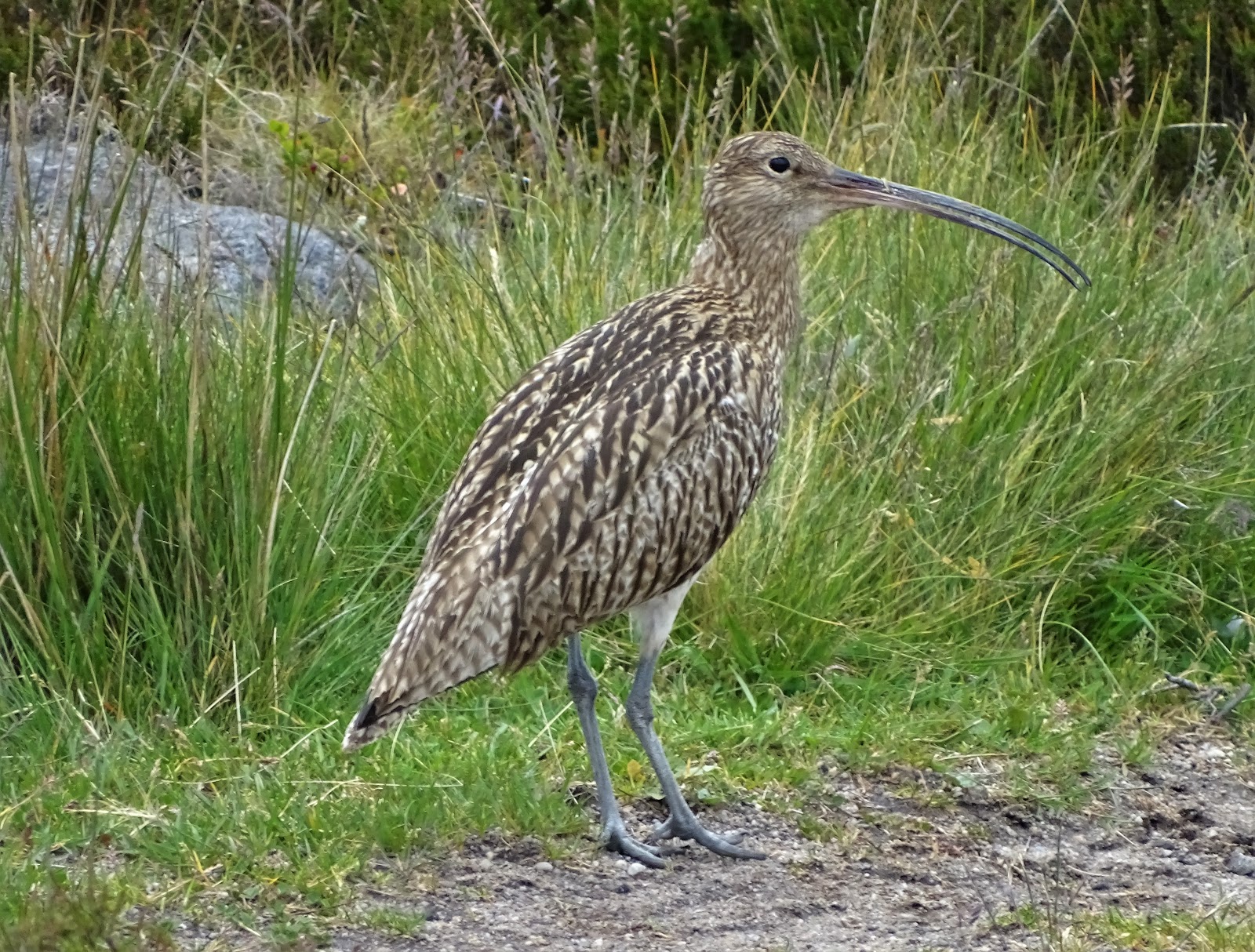
Though their numbers are in worrying decline, curlews are often seen in summertime on the moors west of Sheffield. Their plaintive calls are as distinctive as their elegantly curved bills - designed for investigating mud flats or prising worms from the earth.

Yesterday, I took a short walk from Redmires to the small reservoir at Oaking Clough. I heard and then spotted a curlew in the scrubland above Rivelin Brook. My camera possesses a good zoom facility so I was able to achieve these shots quite easily. As you can see, it was not a bright, sunny day but even so I am pretty happy with these two images.
And for your interest, here's a short video of curlews complete with call sounds. I found it on the website of the R.S.P.B. (Royal Society for The Protection of Birds). Enjoy!

Most Visits