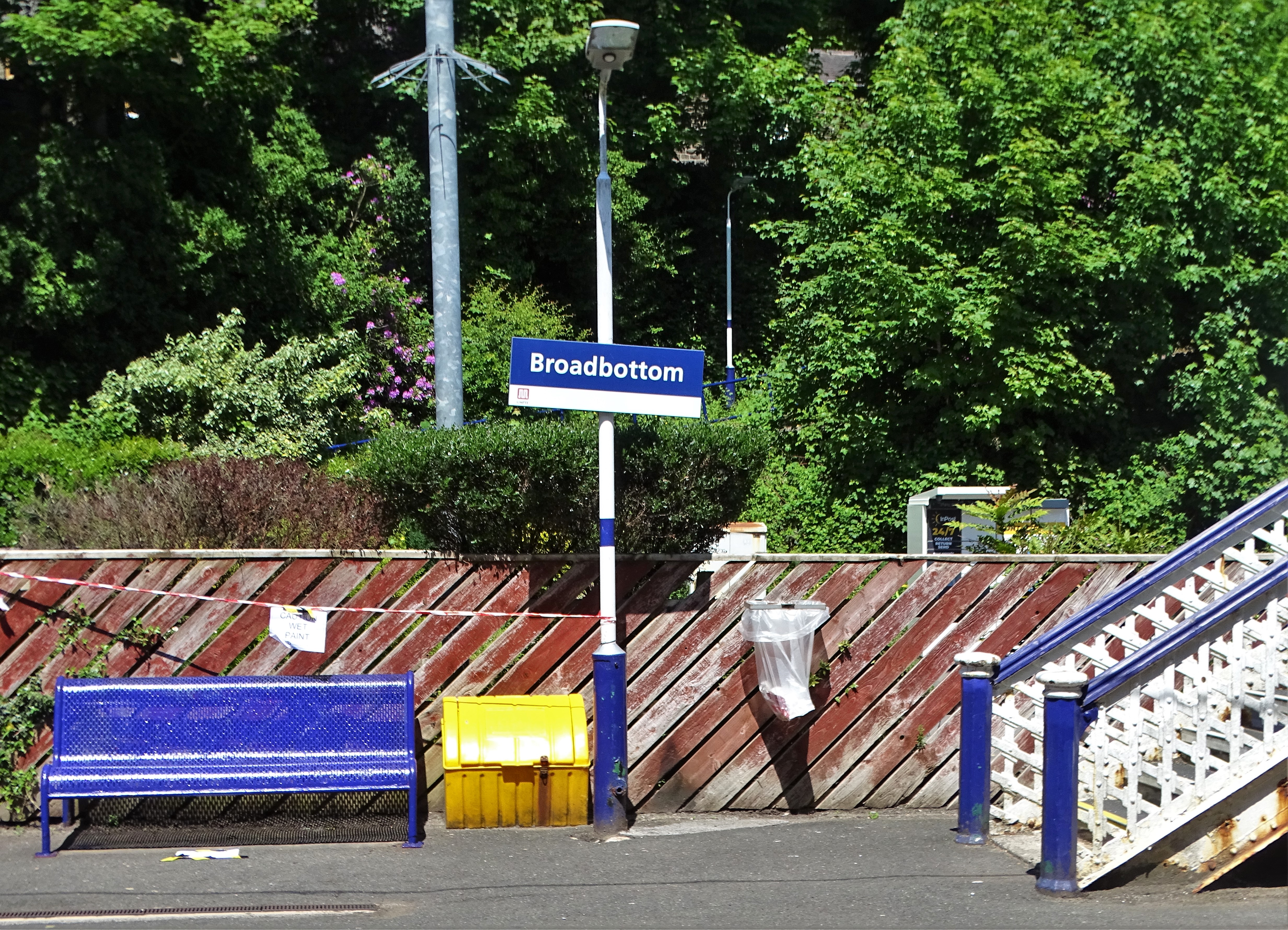
Please don't get me wrong. This blogpost's title does not refer to the wide posteriors of some "Yorkshire Pudding " visitors. No way. I would not be so rude. Broadbottom is a village in Greater Manchester right next to the Derbyshire border.
I was there earlier today. Taking a long hike in the lovely June weather. No need for a jacket. My FDNY T shirt would suffice. I parked Clint near the church in Mottram-in-Longdendale, smeared any exposed skin with sun cream and then set off.
The Hague - near Broadbottom
After eight miles I felt weary in the sunshine. Mottram church was just ahead. I would go over a stile and descend into a wooded valley where a stream ran. Up the other side and then through the cemetery to the old church.
But just one problem. Cattle! They were milling around near the stile . A motley crew of around thirty - including a few calves. They had broad bottoms. There was no way that I was going to panic them. They seemed very interested in me - as if I was a pop star getting off an aeroplane. A diversion was in order.
Through long grass. Half a mile to the top of the sloping ground and then right past a pond. Over a couple of barbed wire fences and then up to the blackened church on a hill. Was the artist L.S.Lowry buried here? I don't know but he lived the last years of his life in this village.
I changed my footwear and put my hairy broad bottom into Clint's cockpit, ready for the hour long drive back to Sheffield via Glossop and The Snake Pass. Yet another "Grand Day Out". I could say more, much more, but on this occasion I won't.
The parish church in Mottram - dedicated to St Michael and All Angels
Beau and Peep were bathed in the light of a gorgeous summer's morning on Saturday. It was 5am and with camera in hand, I padded out upon our lawn in my bare feet. They have been out there for a long time now. The mother - Beau arrived from Nottingham in October 2011 and the lamb, Peep arrived at Christmastime in the same year.
They have been no trouble and have often given momentary delight to visitors and tradespeople alike. "Oh! I thought they were real!" is a remark we have often heard which is something of an insult to Beau and Peep because they are real! I overheard them...
PEEP Mummy? What's a pandemic?
BEAU Shut up and keep eating the grass!
Soon after snapping these pictures, the sun arched higher and the shadows of houses and trees swept across the lawn till Beau and Peep were no longer bathed in that lucid morning light. The moment was gone.
Lying abed this morning with BBC Radio 4 playing on our radio alarm clock, vague memories of when I was a choirboy came to the surface of my mind. On Sunday mornings, Radio 4 focuses upon religion and there are church services complete with hymns, sermons and prayers. Memories returned like flotsam on waves.
I was a choirboy from the age of ten to fourteen. I can't remember how I ended up in our village church choir but I have always loved singing and my father was a church warden and regular churchgoer so that may explain it.
As a choirboy, I had to attend choir practice every Friday evening ready for Sunday. When "The Sabbath" arrived there were two services. One began at ten in the morning and the other was I believe at six thirty in the evening.
In those four years, several hymns became very familiar and I knew some of them by heart. Even today I can still sing whole verses from memory. One of my favourites was "Ye Holy Angels Bright" written by Richard Baxter in 1681 but sung to an even older tune called "Darwall":-
Ye holy angels bright,
Who wait at God's right hand,
Or through the realms of light
Fly at your Lord's command,
Assist our song,
For else the theme
Too high doth seem
For mortal tongue
The hymns were filled with archaic language and strange notions - such as angels flying through "realms of light" like an angelic air force commanded by their omnipotent leader - the unseen "God" figure who seemed to get everywhere. The echoes of those hymns with their unmodern English have remained with me and have certainly influenced my appreciation of language.
As a choirboy, I had to wear a ridiculous outfit and I am very pleased that there are no surviving photographs of me in this garb. First there was a long black cassock that reached the floor and was buttoned up the front. Over this you wore a white surplus - a loose kind of smock that reached just below the waist and had baggy sleeves. Last there was the white ruff which I wore round my neck. Our outfits hung on pegs in the vestry and I have no idea if they were ever laundered. I guess they must have been once in a while.
Being a choirboy was not just about the singing. There were interminable prayers and even longer sermons to endure - delivered by vicars and canons whose voices droned on and on from the stone pulpit. Would they ever end? You would think that religious belief would instil believers' hearts with animated, radiating joy but those prayers and those sermons were so tiresome, so dull, so very unconvincing. To me they added weight to my growing but unspoken belief that it was all one enormous confidence trick, played out over centuries of tomfoolery and communal arm-twisting.
Just as I don't recall how I became a choirboy, I don't remember how I extracted myself from the role. By fourteen, my atheism was now pretty well-formed and I had for example spoken about it with my mother who was also unconvinced by all the religious rigmarole though she kept this quiet for my father's sake.
No longer would I sing in the village church where I was christened in the springtime of 1954 and where I delivered my mother's funeral eulogy in September 2007. No more a choirboy was I, but even now the hymns still echo and my interest in church buildings and the impact of Christianity upon this kingdom persists. You can take the boy out of the choir but you can't take the choir out of the boy.
Your intrepid reporter was in Nottinghamshire yesterday. After four and a half hours of plodding along public footpaths, I was having trouble getting back to the village of Bole where Clint was waiting for my return.
First of all, I found a lane barred by a spiky metal gate just south of Middle Farm, West Burton. I am not sure who placed it there - possibly the electricity company that oversees West Burton power station that looms over that district. According to Ordnance Survey mapping, there should be no gate there and public access should not be restricted.
Oh dear! I had to find another way back to Bole and my grumpy vehicle. My map told me that there was an alternative path just along Sturton Road. Fortunately that minor road is not too busy but I had to mount the verge for safety three or four times before reaching the footpath sign.
Polytunnel with strawberries at Wheatley Wood Farm
I should add at this point that the author of this blogpost's legs were bare. Given the good weather, I had for once decided to don shorts. Bad move!
I approached the corner of a field where there was indeed a rickety old wooden stile. This path had clearly not been walked by anybody in ages. Over the stile and then horror of horrors - no clear path just a bed of nettles woven with galium aparine (sticky willy). Ahead of me I could see Bole - no more than twenty yards ahead.
There was nothing for it. Knowing that my bare legs would be nettled, I pressed ahead in a brazen act of self-harm. Soon after getting through, I could see the nettle rashes rising though at that point there was no particular discomfort. I must have been nettled fifty times or more on each leg.
The gates of Saundby Park Hall
Yesterday evening, when I reached home after an hour long drive, my legs were aglow with nettle rash. It was as if I was wearing electrified stockings and this morning as I write this account, that feeling has not entirely subsided. However, you will be relieved to learn the discomfort was not sufficient to make me cry or disturb my sleep.
Some folk take on ice-topped mountains, sail the seven seas, wrestle with lions or explore the bowels of the earth but your brave hero fought through the nettles of Bole and lived to tell the tale. It's a funny thing to be sitting here with my legs still buzzing some twelve hours after the stinging happened. Luckily, all things must pass.
I wrote my ode to Tetley's bitter after supping four pints of the stuff on Tuesday night. Because of the pandemic, pub closures, production issues etcetera I realised that I had not had a pint of the nectar in over a year. You see not all Yorkshire pubs serve Tetley's. On Tuesday night it was like reuniting with a lost friend.
On Sunday my faithful "Bosch" lawnmower started to whine and the electric motor conked out. I had used that machine for the past fifteen years. It cut a lot of grass - mounds of the stuff. When I checked out possible repair costs, I realised they were prohibitive. It would be more economical to purchase a new mower so I toddled along to B&Q and bought this for £185:-
I know that some of this blog's visitors are keen lawnmower spotters so you will already know that this is a Rotak Universal 650 Corded Rotary Lawnmower by Bosch. I sincerely hope that it gives me the same length of good service as the previous machine provided.
Yesterday was quite a productive day. Out at the back I cut the main lawn. I took the excess plastic recycling to the bins in Tesco's car park at Millhouses. I visited Lidl to spend £75 on groceries. I cut the hedge at the front of the house and chopped up the base of an old single bed. The mattress - which had hardly been slept on - was picked up by The British Heart Foundation to sell in their city centre furniture shop. I made our evening meal - a sausage casserole with mashed potato and green beans. and of course I wrote "Pint O'Tetley's Please" - inspired by Tuesday's pub visit.
The sky is quite overcast as I write so I am glad that I had already decided to take another long walk tomorrow and not today. Besides, Frances and Stewart will be over for tea (Posh people: dinner) this evening. Of course they will be bringing our darling granddaughter who remains a perfect baby, developing nicely all the time.
Fed only on mother's milk, she has become chubby. She can roll over when she is in the mood and when I growl and bark at her she puts her arm out so that I can nibble it. Again - when in the mood - she giggles and she still likes to hear my songs - sometimes falling asleep in my arms. She goes to a baby swimming session once a week, wearing a special swimsuit that prevents leakage.
Though they are not babies, there are several blog visitors who could do with one of those!
Three more recent pictures of Princess Phoebe from her mother's smartphone:-
Pray keep your wine from Burgundy And your Holy Island mead And carefully pull instead for me The beverage that I need A pint of foaming Tetley’s That settles nice and clear Elixir of life itself That’s Tetley’s Yorkshire beer.
I journeyed to the corners Of this planet that we share - Crossing many borders I travelled everywhere. But nowhere was I served A drink that could compare With bitter brewed by Tetley’s The best beer anywhere.
So keep your bourbon whiskey And your stout from Ireland too For foreign drinks are risky Unlike my favourite brew -
The colour of dark amber Our Yorkshire superstar A lovely pint of Tetley’s Settling nicely on the bar.
Following a passing remark that someone made about me last week on another blog, I was going to write about pigeonholing people. In fact I had begun to write the blogpost when somewhere - in the back of my mind - a vague memory stirred. Hadn't I blogged about pigeonholing before?
Using the blog search facility in the top left hand corner of "Yorkshire Pudding", I soon discovered that I had written quite effectively about this human tendency back in July 2015. Why re-invent the wheel? For once, I have decided to re-blog. So here's that original "Pigeonholing" blogpost - verbatim:-
This is a question that often surfaces soon after being introduced to new people - at parties and other social events. But for years it is a question that I have deliberately refrained from asking. I am of the opinion that knowing what somebody does for a living is not of prime importance. I don't wish to define my fellow human beings by the jobs they do.
It may be unintentional but asking the question, "What do you do?" is surely a way of pigeonholing people. If they reply, "I'm a butcher" or "I'm in insurance" or "I'm a surgeon", the cogs in the questioner's brain will whirl instantly as presumptions are silently logged. Presumptions about income and education. That kind of thing. And the questioner will be subconsciously rank ordering - assessing your position in the vocational pecking order.
If somebody asks me "What do you do?", I am often deliberately obtuse. "Oh I like walking and photography - that kind of thing and I am quite keen on cookery. Do you like cooking yourself?" I have also been known to respond, "Why? What do you want to know that for?" which can induce dropped jaws and awkward silences.
For most of us, work is something we do to make money that pays the bills. We can't all be Pablo Picassos or Saul Bellows and what the vast majority of us end up doing is usually an accident of upbringing and circumstance. It shouldn't define us.
I used to rage inside when I heard people making sweeping generalisations about teachers and usually felt like yelling back, "But that's not me!" I was always more than that person at the front of a classroom, teaching lessons and marking books. This was only what I did for a living. It wasn't me.
In my philosophy, road sweepers are equal to magistrates, captains of industry are equal to the cleaners who vacuum their offices and celebrities are no better than the unknown.
Of course, in the passage of time, information about what somebody does for a living will emerge naturally. It's knowledge you can pursue or not but I will never be the first to ask, "What do you do?"
Incidentally, for anyone who tries to diminish or stereotype me again - as just "a teacher", I should point out that I have also worked as an operative on a turkey farm, a clerk in a Butlin's holiday camp, a night-watchman at a caravan factory, a factory worker at an agricultural chemicals business, a technician in an amusement arcade, a camp counsellor, a poll clerk in a polling station, an examiner, a fruit picker, a singer in a rock band and a shop worker. But none of this really matters because making assumptions about people on the basis of what they do or did for a living is in the same vein of ignorance as racial stereotyping.