8 November 2015

Remembrance

Sitting in front of the television as eleven o'clock approaches on Remembrance Sunday. The BBC are showing us tales of war and the deaths of ordinary young men...on Flanders Field, Dunkirk and Arnhem, Korea, Afghanistan, Iraq... and of course you could go much further back in time. A line of silent young men, going back over the hills as far as the eye can see and way beyond. "Nimrod The Hunter" by Edward Elgar is played by the mass military bands at London's Cenotaph and my eyes fill with tears for all those lost boys. The ones who never came home.

Nearly all of Great Britain's towns and villages contain war memorials for their local heroes - the war dead. You can see some of them here. Now The Queen is standing by The Cenotaph as we wait for Big Ben to chime eleven times. Lest we forget...

7 November 2015

Epigram

Inscribed under this blog's title I have always had this epigram:-

"O God, I could be bounded in a nut shell and count myself a king of infinite 
space, were it not that I have bad dreams." - Hamlet Act II scene ii

But in ten years no visitor has ever commented on it. So I thought that maybe it is nigh time to take the proverbial bull by the horns myself  and reflect on a line from Shakespeare that I first spotted forty years ago

Incidentally, when I watched the excellent 2012  film "Lincoln" starring Daniel Day-Lewis, I was startled to hear Lincoln relating a dream to his wife Mary (pet name Molly). He says:-
"It's nighttime. The ship's moved by some terrible power, at a terrific speed. Though it's imperceptible in the darkness, I have an intuition that we're headed towards a shore. No one else seems to be aboard the vessel. I'm very keenly aware of my aloneness. I could be bounded in a nutshell and count myself a king of infinite space, were it not that I have bad dreams. I reckon it's the speed that's strange to me. I'm used to going a deliberate pace. I should spare you, Molly. I shouldn't tell you my dreams."

Let's take the first part of the quotation - about living in a confined nutshell and yet seeing oneself as a king of infinite space. To me this suggests a prisoner, a hermit or a monk in a narrow cell, separate from the world. It could also be an Amazonian forest dweller, a Himalayan goatherd or Stephen Hawking. And yet, and yet... the power of the human mind, of memory and imagination could take you far from the nutshell - bursting with ideas and hope and happiness. I certainly think that it is possible to have a rich and fulfilling life even when one's everyday boundaries are very restricted.

The counterpoint to that notion is that it is possible to live an unfulfilled and spiritually impoverished life when one has enjoyed boundless opportunities - far different from the nutshell confines that Hamlet reflected upon. You could get millionaire travellers who despite their privilege and the things they have witnessed have in actuality never really seen anything. George W. Bush springs to mind.

But to the first part of the quotation Shakespeare added the rider, "...were it not that I have bad dreams". In other words, human beings are typically troubled by their guilt, their mistakes and the sensation that we are always living in the shadow of what could have been and perhaps what could still be. No matter how close we get to nirvana, there will be nagging doubts, feelings of restlessness and an underlying dissatisfaction that prevent us from wholly enjoying a transcendental state of being.

5 November 2015

Oak

When King George VI and Queen Elizabeth visited Sheffield and the Upper Derwent reservoirs in late September 1945, it was just three weeks after World War II had officially ended. They rode in an open topped black car along Fulwood Road and through Broomhill where thronging crowds cheered them, no doubt still mightily pleased that war was at last over.

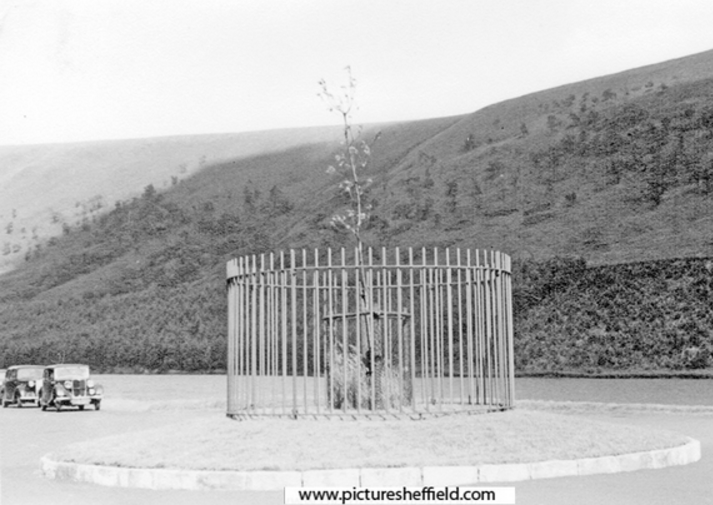
Mistress Jan Blawat of Wesley Mansion, Sloughhouse, California was disgruntled that I did not post a picture of the King's Oak to accompany yesterday's post. I had mentioned it in the text - a commemorative tree planted by King George and his queen on September 25th 1945 close to the head of Howden Reservoir. Not wishing to upset or offend the feisty Ms Blawat, I shall now make amends. Here it is without its summer clothes:-
It is not the most impressive of trees. I doubt that its situation is the best for English oaks - in a deep and often shady valley that can be bitterly cold in the wintertime - but at least it is still growing. Being the obsequious kind of fellow I am I wished to please Mistress Blawat further by finding a picture of the original planting ceremony but I was sadly unsuccessful. Nonetheless, here is the tree in 1946 - a few months after it was planted:-
The railings have gone - probably pilfered by an unscrupulous scrap metal thief in the dead of night. I also notice those bare hillsides that are now clothed under plantations of lofty pine trees. Lower down the valley at the bottom dam - called  Ladybower - the king ceremoniously unlocked the ornamental gates that still stand today even though I notice that those impressive bronze shields have gone. That damned scrap metal thief again!
It crossed my mind to write a spoof speech by King George in which he almost painfully stammered and stuttered out his sentences - purely for your entertainment but then I thought better of it. After all, speech defects are not really funny and having a stammer is a kind of disability. Just as it would be wrong to make fun of paraplegics or blind people so it would surely be in very bad taste to poke fun at stammerers. I taught a few over the years and shared in some of their struggles.

4 November 2015

Derwent

The east tower - Howden Dam
Don't worry. No more ranting about retired politicians today. Instead let me take you ten miles west of Sheffield to The Upper Derwent Valley. Until 1902 it was a peaceful cleft in the earth with moorland streams running down into the babbling River Derwent as it began its winding journey towards the city of Derby. There was a handful of  sheep farms and two tiny villages - Derwent and Ashopton but their remains are now hidden from view under three large reservoirs - Howden, Upper Derwent and Ladybower.

The construction of the reservoirs with their three sturdy dams took over forty years. It was a massive engineering project, punctuated by two world wars and the economic slump of the nineteen thirties, But finally on September 25th 1945, King George VI planted an oak tree near the head of Howden Reservoir to mark the completion of the work.

In the early years of work in the valley a temporary labourers' village was built near Birchinlee Farm and it was known locally as "Tin Town" for obvious reasons. Very little of that encampment remains but one of the tin huts was dismantled in the nineteen thirties and transported to the village of Hope where it is still used as a hairdressers' salon to this day.
Commemorative plaque at the site of Tin Town
On Monday I woke to bright sunshine even though the radio announcers were talking about widespread fog around the country with many flight cancellations and chaotic motorways. After my morning shower, mug of tea and toast with honey,  I was off in my car - westwards to the Upper Derwent Valley on the A57 road which crosses the Ashopton viaduct over Ladybower Reservoir. There was cloud in the valley and soon after I had turned right to travel north to Howden Reservoir, I  just had to stop to take this picture looking back at the viaduct:-
I completed two walks that day. The shorter first walk saw me scrambling like a commando through thick pine forest, fields of bracken and clinging brambles over barbed wire fences, knowing that if I fell nobody would find me for months on end. The second, much longer, walk took me along the River Westend and up on to the windswept moors which lie west of the Upper Derwent Valley. They are the haunt of grouse and blackface sheep. Up on the top the November sunshine was warm upon my skin and so I was pleased that I had chosen to leave my jacket in the car. But down below the Westend Valley was rapidly being plunged into shadowy darkness. It was time to head home.
The end of Ridge Clough
Remains of an old field wall now deep in a pine plnatation 
The track to Dry Clough - up to the moors
Guardian of The Moors
Grouse butt Number 9 on moorland above The River Westend 
Bob the Blackface Sheep says "Baaaa!"

3 November 2015

Blair

Messianic Tony Blair
Photo from his official website
Back in 1997 when Tony Blair became our prime minister, I was delighted. It meant an end to Conservative rule under Thatcher and Major and the possibility that the British state would once again adopt a kinder approach to the poor, the needy and the downtrodden and a more imaginative approach to commerce and industry. No more "I'm alright Jack - pull up the ladder".

The next few years were good. The ship of state did indeed appear to have changed course. "The Troubles" in Northern Ireland were soothed, a massive programme for the building of new schools and hospitals commenced and in  general people seemed a lot more optimistic than they had done under the "no such thing as society" Tories. We were perhaps in Cool Britannia.

But then those aeroplanes hit The World Trade Centre in New York and everything changed. Anxious to remain best buddies with America, Blair was drawn into vengeful and highly questionable military adventures in both Iraq and Afghanistan. It wouldn't have been too bad if he had parachuted in on his own wearing a helmet and a khaki flak jacket but leaders so rarely go to war themselves do they? They just view warfare from afar as other people's sons die.

In 1986
All that killing. All that misery. All that harvesting of bitterness. The British people had made it very clear to Blair that we didn't want our forces to go into Iraq or Afghanistan but he ignored our protests. He ate barbecued meat at George W. Bush's Texas ranch where no doubt he strummed a guitar and sang, "Home, home on the range" as Dubya, in his barbecuing apron, drank a six pack of "Rolling Rock".

It was around that time that I changed my opinion of Tony Blair and began to see him for what he has become - a messianic, unapologetic, self-absorbed, contradictory Catholic convert who has developed dangerous addictions to both wealth and the intoxicating smell of power. He is now as far away from socialism as his £8 million Grade II-listed Georgian townhouse in West London is from Mount Buggery in Australia.

Nowadays, Blair often charges £250,000 a time for public speaking jobs - nine times the average annual salary and heaven knows how much he earned as the blundering United Nations Middle East peace envoy for eight unfruitful years. As "The Independent" said when he resigned from this lucrative post in May of this year - "Only Israel will miss him". 

Blair was born in the same year as me but unlike him, I am unable to buy London homes for my children. Blair bought his three older children homes that cost £1.35 million, £3.62 million and £1.2 million. So much for learning the life lesson that you have to work for what you get. Blair and his scatty wife Cherie own several other properties and it is widely estimated that their combined fortune is around £100 million though naturally Blair would dispute this with his habitual weasel words.

As regular visitors to this blog may recall, I am a lifelong atheist - having "seen the light" when I was a child. On the other hand Christianity has apparently played a big role in Blair's life. He agonised for years about converting to The Church of Rome and made that leap in 2007.

In addition to his appetite for money, Catholicism has become his guiding light. For example here he is at a conference in Rimini, Italy  in 2009:- "In seeking this path of truth, lit by God's love and paved by God's grace, the church can be the insistent spiritual voice that makes globalisation our servant, not our master."

And now I reach the notion that sparked this blogpost in the first place. Isn't religion supposed to be about goodness, love of one's fellow man, humility, recognising that personal wealth is a false and dangerous idol, living a decent life - things like that? As Tony Blair travels between his luxurious Buckinghamshire mansion and his equally luxurious London townhouse, as he refuses to apologise about the killing he helped to unleash in Iraq, as he leaves Labour's core values way behind him, as he signs copies of his odious autobiography "A Journey", does he ever stop to consider that it is all at odds with his purported Christian beliefs - his starry-eyed Catholicism? Personally, I very much doubt it.

2 November 2015

HDR

In photography, HDR stands for High Dynamic Range. It is a technique used in imaging and photography to reproduce a greater dynamic range of luminosity than is possible with standard digital imaging or photographic techniques. The aim is to present the human eye with a similar range of luminance as that which, through the visual system, is familiar in everyday life. The previous sentence was lifted directly from Wikipedia because I don't really understand what HDR is. All I know is that when you use it you can create some rather eye-catching pictures that appear to re-interpret reality.

Above you can see a photograph that I took near Stanage Edge last Thursday. What I saw that afternoon is what you get in that picture - untouched and unaltered - just the gate, the rough pasture and beyond that part of the rugged escarpment that is Stanage Edge.

Back home, I put that same picture into Lenovo "Photomaster" on this laptop. Then I looked at a range of possible "effects" and selected the following two HDR preferences to show you how a relatively ordinary photograph can suddenly become rather eye-catching and other worldly. Of course you wouldn't want to apply this visual chicanery every time you present a picture to other people for very often what we want to see is untainted reality - the truth and too much messing about with pictures can prove quite tiresome.

What do you think?

1 November 2015

Chapel

On Friday afternoon, as I was rambling near Stanage Edge, I looked down into the North Lees Valley from Bole Hill and zoomed my camera in upon the ruin you can see in the picture above. It is all that remains of an old Roman Catholic building called Holy Trinity Chapel. Long ago it served nearby North Lees Hall and was built, like numerous English churches, close to a holy "well" or spring that was venerated for hundreds of years before Christianity appeared on the scene.

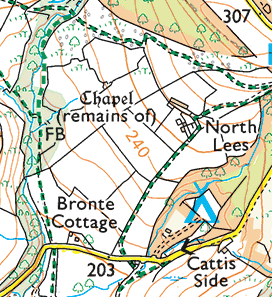
Yesterday (Saturday), I decided to make a closer investigation of the chapel site. Shirley came with me instead of going shopping in the city centre. It is only ten minutes by car from our house to North Lees. We parked up near Bronte Cottage and headed north for a few hundred yards.

Sheep were grazing around the chapel, ignorant of its history but co-incidentally, as we were mooching around the ruin, a young farmer from North Lees Farm appeared at the top of his field with a sheepdog. The flock of a hundred or more were quickly rounded up and moved on to a higher pasture, leaving the old chapel to us.

Naturally, I snapped several photographs and later used the internet to research the site.

A lot of mystery surrounds it but it is thought to have been built in the fifteenth century. Its destruction - possibly in 1688 - may well have been a symptom of continuing antagonism towards The Roman Catholic religion and its influence on British life. This is essentially what The Gunpowder Plot of 1605 had been all about and there are hundreds of other examples of violent rebellion against a religion that had once dominated virtually all aspects of British society since the time of William the Conqueror whose invasion of England in 1066 had been sanctioned by Pope Alexander II.
There isn't a lot to see at the ruinous site of Holy Trinity Chapel. The destruction was pretty comprehensive but the place remains evocative in its lovely, remote setting. You sense the presence of those who once knelt here and if you close your eyes you might hear the sound of their papish prayers. Opening your eyes once more, you might wonder about the fury that once drove men to destroy churches, great abbeys and even little field chapels like Holy Trinity. And if they could do that to buildings what were they doing to their Catholic cousins?

Religion had and still has a lot to answer for. So much anger. So much killing. And all this from people who purport to subscribe to holy creeds that champion love, tolerance and prayer.

Most Visits